

write a new articles with
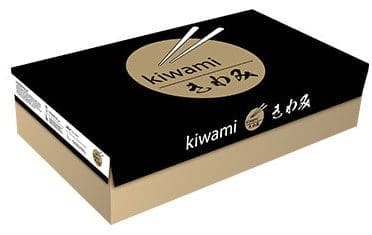
Sample of Stockyard’s Kiwami Wagyu brand, that topped entries in the Brisbane Show Branded Beef competition this morning
BEYOND the glitz and glamour associated with winning one of Australia’s premier branded beef competitions this morning lies a back-story about the tremendous challenges being faced by high quality beef brand owners due to a laundry-list of geopolitical tensions and trade access challenges.
Queensland-based Stockyard Beef claimed its seventh Brisbane Show grand champion branded beef award in the 2026 competition, results from which were announced this morning.
Having won six straight Brisbane Show championships between 2017 and 2022, Stockyard’s Kiwami Wagyu brand returned to the major winners’ circle in results announced in Brisbane this morning (full results at base of page).
The grand championship winning entry representing Stockyard’s flagship Kiwami Wagyu brand, limited exclusively to carcases grading marbling scores 9+ from cattle fed +400 days at Stockyard’s Kerwee feedlot near Jondaryan. The sample topped a highly competitive list of about 45 branded beef entries competing in five grain and grassfed classes this year.
Stockyard is arguably Australia’s most successful branded beef competitor, having earned an incredible 209 championships or gold medals in national taste-test competitions, dating back as far as 2000.
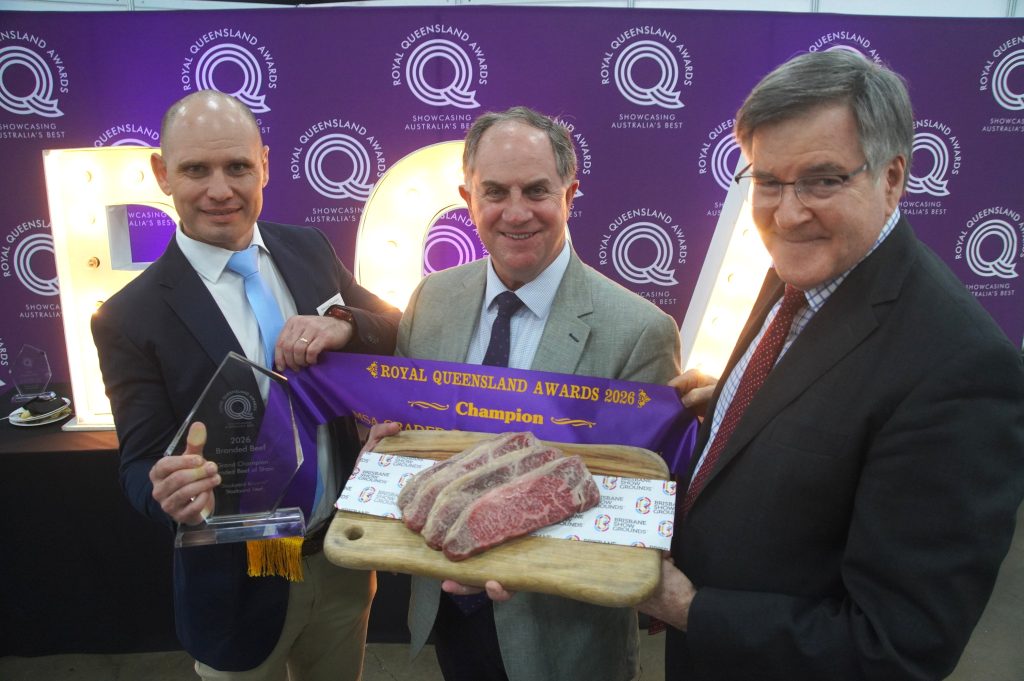
Stockyard’s Marcus Doumany and Lachie Hart, with RNA president David Thomas, with this year’s grand champion branded beef winner
Brand managers finding creative logistical solutions to keep ME customers suppled
Twenty six years after securing its first trophies in the Gourmet Traveller Foods Awards and Melbourne Show Fine Food Awards at the turn of the century, this year is proving to be one of the most challenging ever seen for Stockyard, from a logistics perspective.
With the Middle East region representing a considerable chunk of Stockyard’s high quality Wagyu beef export market, this year’s Iran conflict and its spill-over into the nearby Strait of Hormuz has created unprecedented logistical challenges.
The closure of the Strait of Hormuz has made sea freight shipments into the Middle East region itself, and into other destinations like Europe extremely challenging or impossible
 Stockyard Group chair Lachie Hart told Beef Central that along with the rest of Australia’s high quality marbled beef export brands, Stockyard’s Wagyu and Angus export programs were under a lot of pressure in 2026.
“We’ve all been impacted significantly by all of the export market disruptions seen this year – from Trump tariffs into the US, to China quotas on beef exports, to the latest geopolitical impacts in the Middle East,” Mr Hart said.
Simply getting product into the Middle East region this year has been challenging since the US attached Iran in late February. The ME region accounts for 25-30pc of Stockyard’s total beef exports, making it the number one regional destination, and number two for Wagyu alone.
Stockyard even explored the prospect of chartering its own dedicated air freight service to keep Middle East customers supplied, but ultimately found the process too difficult.
 “We got very close to putting it all together (with some product also from other branded beef programs), but it ultimately didn’t come off,” he said.
“There’s still enough capacity in freight on regular air services to get by, at this stage.”
“But considering all of the market disruptions we’re experiencing, particularly in the Middle East, our logistics team has done an incredible job in keeping trade going this year,” he said.
“We’re not carrying any more inventory this year than normal – despite all the disruptions,” he said.
“We’re keeping our important Middle East chilled customers happy, getting enough product in there via regular airfreight services (typically in the cargo holds of passenger aircraft holds), together with getting some sea freight in via alternate ports away from the Strait of Hormuz.”
Some of that involves overland shipments via countries like Oman and Saudi, into Stockyard’s largest ME market in Dubai, along with other important markets like Kuwait, Jordan and Bahrain, via the Red Sea.
Asked whether it was only because Stockyard’s output was such high quality beef that such logistical efforts were being made, he said it was critically important to maintain trade relationships.
“This war will eventually be over, and we are trying hard to maintain those relationships with our important customers in the region,” he said.
“Stockyard wants to be seen as a reliable export supplier – we don’t just pull out because things get too hard – so that when the ME market does get back to normal, we’re there.”
Beyond the logistics challenges faced in and around the Middle East, the Wagyu sector faced a challenging second half due to the imminent quota filling in China, and not long after that, South Korea.
“Everybody involved in the high quality end of the beef industry is worried about that,” Mr Hart said.
“China has been a fantastic market for the Australian beef industry for our grainfed trimmings, paying premium prices for a product that is not necessarily suited to the US lean trim market (blended with fattier US domestic trimmings).
“We are now seeing that starting to pull back, on demand, so yes – we’re worried about how the second half looks,” he said.
“But wherever you see market disruption, you’ll see suppliers and their customers coming up with innovative solutions to keep trade open. There’s talk of some Chinese customers freezing down high quality chilled Wagyu to provide a source of supply later in the year when the quota fills. We prefer not to consider it, because you’re carrying the cost of inventory, and there is the obvious impact on the quality of the meat once it’s thawed. It’s not ideal.”
On top of the recent rise in feedgrain prices, Wagyu brand owners had some headaches coming their way during the second half, Mr Hart said.
“But demand is still there,” he said. “Consumers everywhere still want to eat red meat, and beef is the best protein to eat because it is nutritionally dense. But we have to have restaurants (food service) in the game.
“Currently, across the Middle East, restaurants have been wiped out by recent events – but we are seeing a COVID-type effect where consumers are buying that higher quality product to cook at home. It means demand at retail across the ME at present is very strong. For that reason we’re trying to get as much product into those markets as we possibly can, but we’re also absorbing a lot of cost in getting it there.”
RNA branded beef winners
Queensland grainfed supply chains Stockyard Beef and Stanbroke shared the honours in the four contested classes involved in this year’s RNA branded beef competition.
Stanbroke topped the Wagyu class for entries showing marbling scores of 6 or less with a sample from the company’s Diamantina Wagyu SB6 program, and the open class with a sample from its Black Onyx SB7 program.
Chief cattle steward Gary Noller said entries remained high at 45, despite a noticeable drop in the grassfed class due to seasonal conditions in Northern NSW and southern Queensland.
“Beef brand programs are not only about consistency in the eating quality of the product itself, but also the consistency of supply on a year-round basis,” he said.
“Clearly that is harder for grassfed than grainfed programs, when seasonal conditions turn.”
Chief judge Elaine Millar said the 2026 competition’s beef entries delivered a wonderful diversity in flavour, texture and visuals yet exceptional consistency in quality.
Ms Millar said Stockyard’s grand champion showcased outstanding qualities – abundant marbling, perfect lasting yet retained juiciness, melt in the mouth texture and silky tenderness, along with beautifully well-balanced, complex flavours.
In the parallel RNA branded lamb competition also announced this morning, Midfield Meat International’s Union Station brand based out of Victoria produced the Champion Branded Lamb of Show.
“The 2026 Champion Branded Lamb Union Station by Midfield Meat International delivered stunning complex flavours paired magnificently with fine silken texture resulting in a harmonious mouthfeel and an ongoing lasting length on the palate,” chief judge Elaine Millar said.
The Royal Queensland Awards recognise and celebrate Australia’s finest food and beverage products and the producers behind them across seven categories – distilled spirits, beer, wine, beef, lamb, dairy and ice cream. Some of today’s award-winning products will be showcased on the Royal Queensland Cooking Stage at the Royal Queensland Show (Ekka) in August.
RNA branded beef trophy winners
Champion MSA-graded branded beef of show: Stockyard Gold, exhibited by Stockyard Beef
Grainfed MSA Graded Class:
- Gold: Stockyard Gold by Stockyard Beef
- Silver: Sir Thomas by Mort & Co
- Bronze: Angus Reserve Black Angus Beef by NH Foods Australia
Wagyu beef marbling score 6 or less
- Gold Diamantina Wagyu – SB6 by Stanbroke
- Silver: Tajima Australian Grainfed Wagyu by Andrews Meat Industries
- Bronze: Carrara Wagyu by Kilcoy Global Foods
Wagyu beef marbling score 7+
- Gold: Stockyard Kiwami by Stockyard Beef
- Silver: W. Black by Andrews Meat Industries
- Bronze: The Phoenix by Mort & Co Ltd.
Open Class
- Gold: Diamantina Black Onyx – SB7 by Stanbroke
- Silver: JBS Australia Yardstick MB2+ by JBS Australia
- Bronze: JBS Australia Riverina Angus MB2+ by JBS Australia
Branded lamb trophy winners
Branded Lamb – 20kg or less
- Gold: Ambassador by Australian Lamb Company/Minerva Foods
- Silver: Coles Finest Lamb by Coles
- Bronze: Royal Trade by Royal Wholesale Meats
Branded Lamb – 20-24kg
- Gold: Union Station by Midfield Meat International
- Silver: Tasmanian Royal by Royal Wholesale Meats
- Bronze: Royal Trade by Royal Wholesale Meats
Restaurant Trade Branded Lamb – 24kg or more
- Gold: Sovereign by Australian Lamb Company/Minerva Foods
- Silver: Tasmanian Royal by Royal Wholesale Meats
- Bronze: ‘246’ by Midfield Meat International.
into a unique and well structured article. Ensure the new content is plagiarism-free, well-organized, and formatted for seamless integration into WordPress. Use appropriate HTML tags (e.g.,
,,
) and enhance readability with proper formatting

