

Emergence of Japan’s Food Innovation Ecosystem: Investment and Collaboration on the Rise
Japan is witnessing a significant maturation of its food innovation ecosystem, characterized by a surge in agrifoodtech startup investments and the formation of new cross-sector partnerships throughout the value chain. This momentum was prominently showcased at the recent SKS Japan Summit held in Tokyo, where innovators, investors, and agrifood corporations underlined the necessity of collaboration to strengthen the ecosystem.
Why This Matters
During the conference, speakers including Japan’s newly appointed agricultural minister frequently addressed the sector’s challenges. The alarming reality is that over 80% of farmers in Japan are over 70 years old, and the country is heavily reliant on food imports, with more than 60% of its food sourced from abroad.
Rising Investments in Agrifoodtech
The Surge: Japan’s share of Asian agrifoodtech investment has escalated to 13.0% in 2025, up from 6.1% in 2024, according to AgFunder research presented at the event. Within Asia, Japan now ranks as the third-largest agrifoodtech investor, trailing only India and China.
Investment Focus
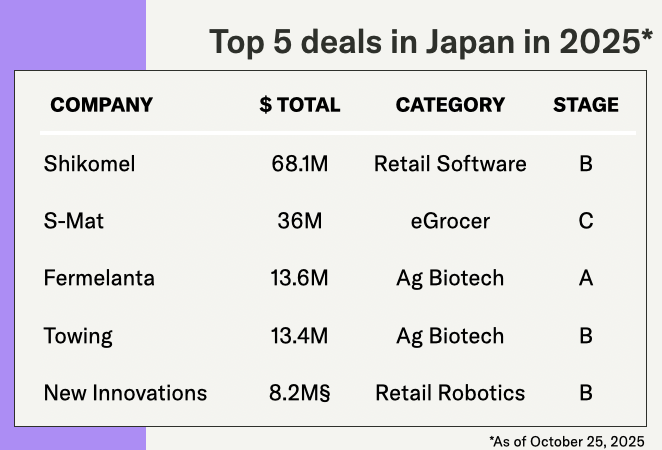
What is Being Funded: The top five deals in 2025 have primarily targeted consumer-facing innovations, with three out of five being deep-tech ventures. Notable examples include biotechnology firms Fermelanta and Towing, and restaurant robotics startup New Innovations.
Impact of AI on Funding
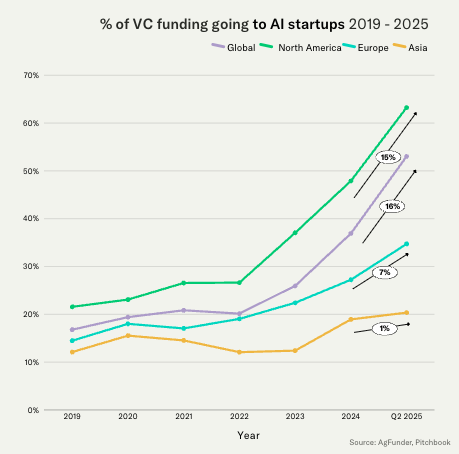
There has been a notable decline in agrifoodtech funding from the US as venture capitalists concentrate nearly 65% of investments on AI startups in Q2 2025. Although Asia continues to trail behind the US and Europe in AI funding, Japan, alongside China and South Korea, is leading the charge in attracting venture capital for AI initiatives, as noted by PitchBook.
The Global Context
While global agrifoodtech venture capital continues to decline, regional dynamics are evolving. For the first time on record, Europe and the US are nearly on par, with the US accounting for just 38% of total global agrifoodtech funding this year. Meanwhile, Asia has successfully captured 23% of the global investment landscape.
Partnerships Flourish Across Sectors
Emerging Collaborative Models: The conference highlighted various new partnerships spanning finance, real estate, and food companies. Notable collaborations include:
- MUFG’s Food X Project: This initiative underlines the collaboration between traditional financial institutions and food companies, focusing on competitiveness, open innovation, and navigating international regulations. The project includes financing support, quarterly meetings, and an accelerator program.
- Tata Mono’s Test Kitchens: Plans to establish test kitchens and food startup hubs were announced by the real estate company, further supporting innovation.
- Givaudan x Bühler’s Protein Innovation Centre: This initiative exemplifies cross-industry collaboration aimed at accelerating product development.
A Cultural Perspective: “Collaboration” was a recurring theme, noted Tobias Pegg, CEO of the US indoor farming platform Square Roots, who is building a presence in Japan. He emphasized the cultural inclination towards collaboration to enhance communities and improve society as a whole.
Unique Market Characteristics and Strengths
Emphasis on Food Quality: Pegg pointed to Japan’s remarkable food quality as a core strength of its agrifoodtech ecosystem, which not only establishes a benchmark but also creates a mission to preserve traditional food culture.
- Many traditional foods, including seafood and rice, face climate change threats, leading to a collective responsibility to protect these culinary treasures.
Functional Ingredients: The presence of GABA-enhanced products in Japan’s retail space highlights innovation, with examples like fiber-infused Coca-Cola indicating the potential for successful products beyond Japan’s borders.
- Convenience Proteins: Innovative offerings such as refrigerated chicken breast pouches available at 7-Eleven resonate with contemporary consumer protein consumption trends.
The AI Revolution and Internationalization Challenges
As generative AI reshapes recipe development and accelerates R&D timelines, Japanese corporations are keen to leverage technology for transformative product development. However, despite these strides, Japanese food startups have faced challenges in gaining traction in broader Asian markets.
Diversifying Innovation
Michael Wolf, founder of the Spoon and the SKS Summit, noted that Japan’s startup ecosystem is diversifying considerably, moving beyond its initial focus on alternative proteins and home cooking technologies. The 15-company pitch competition during the summit showcased an array of innovative solutions, highlighting the broadening scope of Japanese agrifoodtech.
- Innovations presented ranged from seaweed-farming data services and fermentation innovations to automated beer dispensing using AI and facial recognition.
High-Level Participation: The senior executives from food companies, startups, and real estate sectors attending the SKS Summit underscored the significance they place on food innovation. “Conversations in the corridors and backstage involved individuals capable of driving change,” Pegg remarked.

