

write a new articles with
Navigating Parasite Management on an Organic Sheep Operation
Written by Mary Hathaway, OFRF’s Research & Education Program Manager, and Amy and Madeline Lucas, FLT Program participants
This on-farm trial at Chestnut Acres Farm will test the effectiveness of using an organic oral drench of black walnut powder, garlic powder, and molasses to reduce internal parasite-load in sheep. Results from this study will help organic farmers manage parasites while adhering to organic certification requirements.
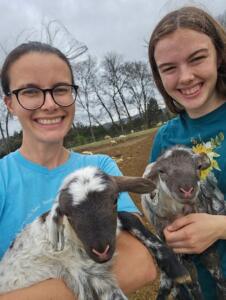
Amy Lucas and her daughter Madeline with the lambs of Chestnut Acres Farms.
Nestled in the Tennessee Valley, in Kelso, Tennessee, Chestnut Acres Farm is a small, diversified family operation. Managed by the Lucas family, they specialize in three main areas: seasonal produce, pastured lamb, and free-range eggs. Central to their farm is a commitment to sustainable practices, including the cultivation of an organic orchard. They began the process of transitioning the land to organic in 2023; in early 2026 the farm completed organic certification inspection and now offers certified organic produce, eggs, and lamb to their community.
Organic Solutions to Parasite Challenges
One of the most persistent challenges facing small-scale organic sheep producers is managing internal parasites, particularly barber pole worm (Haemonchus contortus), without relying on conventional chemical dewormers. For the Lucas Family, this challenge became especially acute as they worked toward organic certification. Organic certifiers require that any product used on livestock be specifically labeled for use in that species, a restriction that eliminates many of the herbal and botanical products commonly discussed in the small-ruminant farming community.
Over the years, the Lucas Family have employed rotational grazing across 18 acres of pasture, moving the flock every three days in summer, and weekly in winter, as a key strategy to interrupt parasite life cycles. While this practice helps reduce pasture contamination, parasite pressure in young lambs remains a significant concern. Lambs begin consuming grass at just a few weeks of age, rapidly exposing them to infective larvae on the pasture. Finding an effective, certifier-approved intervention to reduce parasite loads during this vulnerable early period has been a persistent need on the farm.
After researching botanical options and consulting with their organic certifier, Madeline Lucas, with the help of her parents, identified an oral drench using a combination of black walnut powder, organic garlic powder, and organic molasses as a promising approach that could be approved for use on her certified operation.
into a unique and well structured article. Ensure the new content is plagiarism-free, well-organized, and formatted for seamless integration into WordPress. Use appropriate HTML tags (e.g.,
,
,
) and enhance readability with proper formatting




