write a new articles with
Interseeding Sunn Hemp for Soil Health and Hay Production
Written by Mary Hathaway, OFRF’s Research & Education Program Manager, and John O’Meara, FLT Program participant
This on-farm trial at O’Meara Family Farm will compare sunn hemp grown alone with sunn hemp interseeded with Japanese millet for hay production. Results from this study will help organic farmers determine whether interseeding can improve forage yield and quality while supporting soil health.
 Source: O’Meera Family Farm
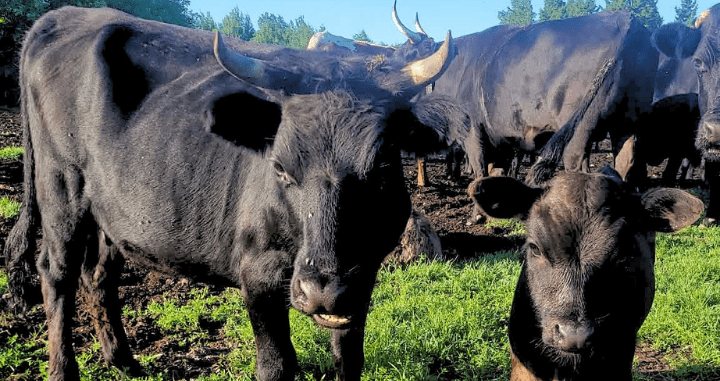
 Cows grazing at O’Meara Family Farm.
O’Meara Family Farm is a certified organic livestock operation located in Northern Maine, near the Canadian border. Founded in 1999, the farm grows grain and raises grass-fed beef, pork, lamb, and geese. The farm comprises 160 acres, 110 of which are wooded. In addition, John farms another 100 acres of organic land that he does not own. The farm spans two properties located about half a mile apart. The property where John lives has generally higher-quality soil, while the second has been steadily improved since he purchased it and continues to benefit from ongoing land rehabilitation efforts. The operation has been certified organic since 2005 and has participated in the Real Organic Project since 2021.
The heart of John’s approach is a commitment to the health, happiness, and longevity of his animals and the land management practices that make that possible. His farming vision centers on increasing productivity and building soil fertility, with a particular interest in finding crops that serve double duty: first as hay, then as grazing ground. In past summers, John focused primarily on grazing and making hay from local grasses, but now he is shifting to incorporate summer annuals into his hay production. Sunn hemp (Crotalaria juncea), a warm-season legume known for its nitrogen-fixing capacity and rapid biomass accumulation, is a crop that is common in the south, but is not well tested in northern climates.
Finding a Dual-Purpose Forage Crop
One of John’s goals is to rehabilitate fields that have historically been underproductive. The second property, in particular, was farmed intensively for roughly a century, its fertility depleted over generations. While John has made meaningful progress, there is still work to do. He identified several areas that are weedy or low-yielding and began looking for crops that could build soil health while also generating real economic value through hay production.
Sunn hemp stood out as a strong candidate. A tropical legume that thrives in warm conditions, sunn hemp fixes atmospheric nitrogen, suppresses weeds, and produces substantial biomass in as little as 60 days. For a farm where land improvement and forage production are equally important, the crop’s dual-use potential was a clear draw. John had previously explored interseeding it with companion grasses through a SARE-funded grazing project at the University of Maine involving Japanese millet, which gave him a useful starting point.
The core question John wanted to answer was practical: does interseeding sunn hemp with Japanese millet produce higher quality or greater quantities of hay than growing sunn hemp alone? Japanese millet is a fast-growing warm-season grass with a solid track record in Maine. John hypothesized that the two crops might complement each other: the millet adding structure and bulk, and the sunn hemp contributing protein and nitrogen. Getting real data from his fields, under his management, was the motivation behind applying for OFRF’s Farmer Led Trials program.
into a unique and well structured article. Ensure the new content is plagiarism-free, well-organized, and formatted for seamless integration into WordPress. Use appropriate HTML tags (e.g.,
,
,
) and enhance readability with proper formatting