
write a new articles with
Tackling Aphids from the Inside Out: Nutrition, Sap Analysis, and Tomato Health
Written by Mary Hathaway, OFRF’s Research & Education Program Manager, and Dan Perkins, FLT Program participant
This project at Perkins Good Earth Farm will evaluate whether foliar nutrition can improve tomato health and reduce aphid pressure through proactive nutrient management. Results from this study will help organic vegetable growers better understand the impact of timing on aphid interventions.
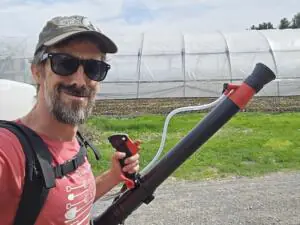
Farmer Dan Perkins with his backpack sprayer.
Dan Perkins farms at Perkins Good Earth Farm, a certified organic, diversified vegetable operation that utilizes no-till, permanent deep-compost beds. Located in De Motte, Indiana, they grow produce and 18,000 bulbs of hardneck garlic for a 200 member CSA, on-farm stand, commercial kitchen, and local wholesale accounts.
In addition to their garlic focus, Dan has spent years refining his approach to high tunnel tomato production, guided by a commitment to proactive plant health management and ecological balance. His farm includes five high tunnels dedicated to tomato production, each featuring long east-west beds that support intensive, season-extended growing.
With an eye toward both soil health and market quality, Dan is invested in understanding the connection between plant nutrition and pest resilience. His work with sap analysis and customized foliar feeding reflects a broader vision: growing crops that are nutritionally robust, naturally resistant to pressure from pests, and consistently high in quality for his customers.
A Proactive Approach to Aphids
For many high tunnel tomato growers, aphids are a recurring and costly challenge. For Dan Perkins, the question has never simply been how to eliminate aphids, it’s been why are they there in the first place? Dan’s approach to pest management is rooted in plant physiology: the hypothesis that plants with well-balanced nutrition are inherently less attractive to aphids. Specifically, Dan has observed that plants with elevated free nitrates, which can signal nutritional imbalance, may be more susceptible to aphid colonization, as those compounds serve as a ready food source for the insects.
Dan has been exploring sap analysis as a proactive diagnostic tool, likening it to “blood work” for his tomato plants. Unlike standard soil or tissue tests, sap analysis captures a real-time snapshot of what nutrients are circulating within the plant, identifying imbalances before visible symptoms appear. Working with Advancing Eco Agriculture (AEA), Dan formulates customized foliar sprays based on sap analysis results that deliver chelated ions directly to plant tissue to rapidly correct deficiencies and support overall plant immunity.
This integrated approach of reading the plant, responding with precision, and then measuring the result, reflects Dan’s broader farming philosophy. Rather than reacting to pest outbreaks after the fact, he wants to understand the nutritional conditions that allow aphid populations to take hold, allowing him to intervene earlier and more intelligently.
into a unique and well structured article. Ensure the new content is plagiarism-free, well-organized, and formatted for seamless integration into WordPress. Use appropriate HTML tags (e.g.,
,
,
) and enhance readability with proper formatting

