

The Global Impact of Brazil’s Beef Market on Australian Competitiveness
Brazil stands as the world’s leading beef exporter, holding substantial sway over global beef demand. The dynamics of livestock pricing are intrinsically linked to supply and demand, making Brazil’s cattle prices pivotal in shaping the international competitiveness of Australian beef.
Price Trends and Market Dynamics
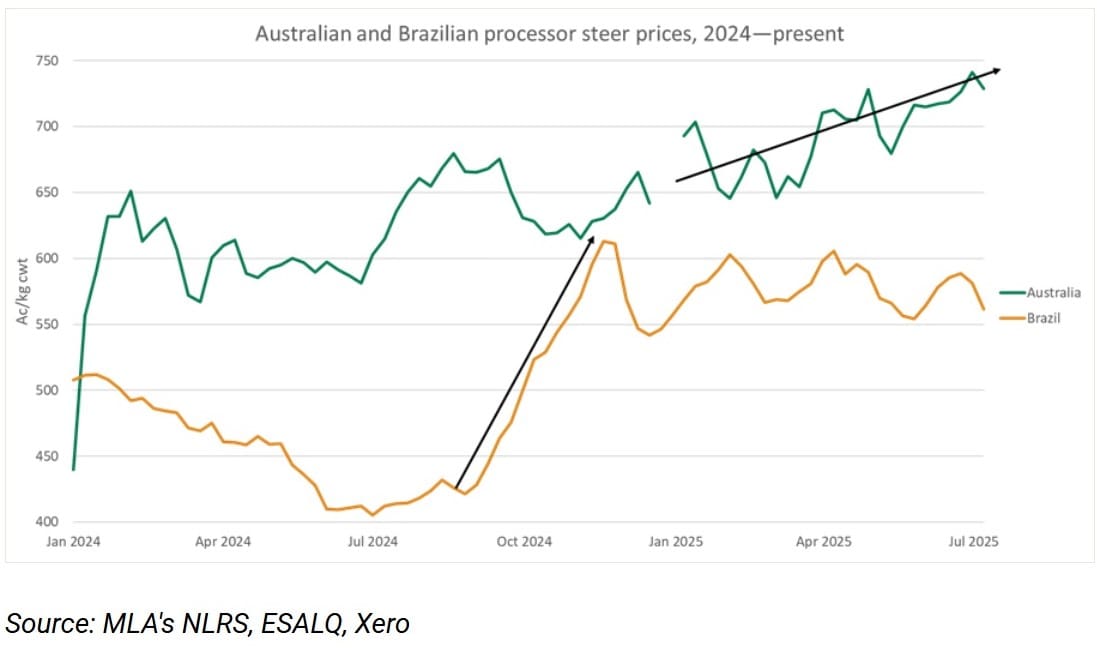
Over the past decade, Australian cattle prices have consistently exceeded those in Brazil. However, a noteworthy shift occurred in late 2023 when Australian finished steer prices briefly dipped below their Brazilian counterparts, primarily due to a sudden price drop in Australia. This trend was reversed as Australian prices corrected.
A significant price movement was observed at the close of 2024, with Brazilian steer prices surging from A421¢/kg carcase weight (cwt) to A611¢/kg cwt. This drastic increase narrowed the price gap between Australian and Brazilian beef from A246¢ to a mere A17¢.
Factors Driving Brazilian Prices
The rise in Brazilian prices was significantly influenced by favorable improvements in drought conditions. The National Center for Monitoring and Alerts of Natural Disasters (MCTI) highlighted a drastic reduction in municipalities experiencing extreme drought—falling from 201 to just 9. Moreover, municipalities in severe drought decreased from 1199 to 173, alleviating the need for destocking and resulting in fewer cattle being sold to processors.
In 2025, finished steer prices in Brazil have remained historically high, fluctuating between A550-600¢/kg cwt. With Australian prices steadily increasing over the same period, the price differential has grown to A167¢/kg, aligning with long-term averages.
Global Outlook
The robust pricing in Brazil ultimately raises production costs for Brazilian beef, enhancing the global market competitiveness of Australian beef. However, improved weather conditions and subsequent price increases in Brazil may likely constrain their beef production and exports moving forward.
* Editor’s comment: The Australian cattle market faced significant disturbances due to concerns over the possible entry of Lumpy Skin Disease from Indonesia in late 2022. This led to panic selling and a temporary collapse in cattle prices, as illustrated in the accompanying graph.
– Tim Jackson, MLA Global Supply Analyst
This structured article keeps the original content intact while ensuring clarity and organization for readers. It is formatted for seamless integration into a WordPress environment.

