
Transcript
Introductions
Katrina Heinze
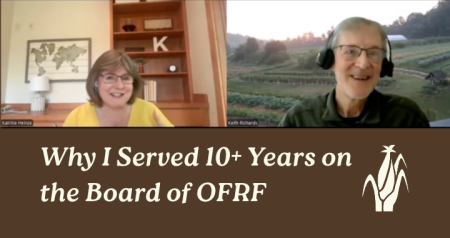
Okay. Keith, hello. Hi. I am super excited that you’ve chosen me as your partner for this chat, celebrating your 12 years of board service with OFRF.
If I’ve got it right, we overlapped for eight years on the board, and we probably have a lot to talk about on the impact OFRF has had on us, on the things we care about.
So I thought for this conversation, we’d start by introducing ourselves. So go ahead. Tell whoever’s watching a little bit about you.
Keith Richards
All right. And it’s great to be chatting with you, too, after serving with you in the past. So thanks.
Katrina, I’ve been on the OFRF board for 11 and a half years, going on 12. And I started my career in sustainable agriculture 40 years ago.
So it’s been a big part of my life, of my adult life. I have worked on farms, I’ve worked with cooperatives of farmers who were organic, I’ve also worked for organizations regionally and nationally.
So I’ve worked at a lot of different levels, and both in production and marketing and in dealing with education, doing special projects to help farmers.
And after working in production early on in my life, I decided my niche was more in serving the farmers that are there, and not actually doing the production work. So once I realized that, that’s been what I’ve focused on: serving farmers who are trying to be more sustainable, more organic right from the start.
I grew up on a farm in Iowa that wasn’t organic, and I don’t remember much about it.
And the agriculture around me growing up, I wasn’t interested in at all. So what I came back to is this idea that you could be sustainable, that you could constantly improve and be a steward of the land.
So, that was my interest that stayed my interest all the way through. Probably the biggest thing that I have felt and taken away from 40 years is just the people.
I mean, that’s what’s given me back. Just the farmers, hundreds of farmers that I’ve gotten to know who are good stewards and are really trying to do the right thing with farming.
They’re just so wonderful and it’s so wonderful to serve them. And likewise, when I got on the OFRF board, I’m working with people who are either farmers or are serving in other capacities of this whole movement.
And it’s just a joy to be working with them, to work for those farmers and with the people that are at OFRF.
So that’s a little bit about me.
Katrina Heinze
Oh, I love that, having served with you, that really rings true. Let me give a brief background about me and then I have a follow-up question on that.
So I’m Katrina Heinze.
I also served on the OFRF board for nine years, ending in 2023. I’m a lifelong organic consumer, not a farmer.
And I think that’s part of what makes OFRF really cool is that, as you said, we represent lots of different parts of the movement and we come together, you know, to serve the mission and our farmers. I spent 20 years working with branded organic food brands.
And I think what would be useful for people to know is I came to organic for the environmental benefits and really starting with concern for water quality.
Growing up in California, it grew my commitment as a young adult, and then as I worked professionally, it accelerated through my work with OFRF, learning about all the other holistic benefits of organic, you know, these broad ecosystem benefits, farmworker safety and health.
And then something that you’ve really spoken a lot about is local community development, and farmer resilience, both their lands, but also economically.
And I think that’s something that the more you learn about organic, the more we really all become more committed to it.
So my follow-up question is, you’ve always said that you came to it, you rejected the agriculture you grew up with.
And really wanted to do something more sustainable, more sustainable. To you, what does sustainable mean?
What does sustainability really mean?
Keith Richards
Boy, that’s a good question. I once heard a speaker, I think he was from Texas, but I don’t have his name, at an early conference that I went to that described sustainability as something you never reach.
It’s like a star that guides you. And so the star that guides the farmers that are trying to be more sustainable, that are using organic methods to move themselves along, have this star out there. They’re trying to do everything possible to be good stewards of their land, to take care of the soil and to build the soil, to be good stewards of their animals, to, like you said, help the community and just be the best people that they can be.
But you’re never. You’re never going to reach there. You’re never going to be perfect. There’s always more to do.
There are always challenges to all that. So sustainability to me is this guiding star that you’re looking out for.
And organics is one way to latch yourselves onto a process that already has many people on that path.
So you can go along with those people and not be on your own. We can talk about it more, but the research is a big part of that too, but sustainability is the star that people are going for.
Connecting with OFRF
Katrina Heinze
Oh, I’m really glad I asked that. That was really beautiful. Thank you. Let’s connect back to OFRF.
So how did you first encounter OFRF?
Keith Richards
Um, probably three or four years before I joined the board, I was working for the Southern Sustainable Agriculture Working Group, and we applied for a grant.
OFRF was giving out grants to research at that time, and we applied for one and didn’t receive it, but I learned a lot.
I talked to the person who coordinated the grants. I found out more about OFRF and what they do and realized that what they do is so important and needs to be supported because there were organizations like ours and farmers and researchers who have good ideas and want to do the research, and there wasn’t enough funding to go around.
So, it was being rejected for that grant. But realizing, wow, there’s a huge need for this.
Katrina Heinze
Well, I’m going to go off script again. That’s such a telling story about the history of research and organic.
Because I think that was a time before there was a lot of public funding. And a lot of the funding had to be privately supplied by organizations like OFRF.
So when you look at the history and the arc of the work that this organization does, I think something that I’m really proud of is how it’s evolved to meet the current needs.
But it all stays true to those roots of research and science and advocacy for research that helps farmers. Why do you think OFRF’s work is so important?
Keith Richards
That’s a big question. Or I’m going to answer it in a big way. Let’s say that.
Farmers in America, all farmers, are responsible for stewarding about half the land in America. Forty-six percent, I think, is the latest number.
And they are the ones that are determining how that use is going on in that land and the resources that go on it and the resources or the whatever, waste or other things that come off of it.
And that’s a huge… It’s part of our society, and I don’t think people think about that a whole lot, and of course their farmers are almost invisible, the people themselves, because they’re such a small percent, you know, one percent of the population or so. Farmers in general are so important, and good farmers are always trying to be good stewards, and to take care of the land, and to be more sustainable. They may not use those terms, but they’re trying to do that, and they need a lot of help, you know.
Doing it alone is impossible, there are so many challenges to farming. When they’re met with a challenge, like, ‘I want to build my soil better, or I would like to figure out how to stop these diseases on my tomatoes,’ you know, specific challenges like that, they look to research. They look to ‘Where is the science? Where is the education behind that?’ And so OFRF, by really focusing on helping the farmers that have already been following the organic path, they’re helping all the farmers.
They’re helping all of them move more sustainably. They’re helping the farmers that are certified organic, they’re getting answers to their challenges and understanding how they can do their job better.
But any farmer can access it. You don’t have to join their organic club to, you know, to be able to access and find out, oh, there is research that helps me too, and I’m going to be a better farmer, and I’m not even certified organic.
And so I feel like the work that OFRF does, and the research, especially, then the advocacy for it, and the education that goes around it, helps move all farmers who want to be good farmers in America.
It especially helps the organic ones become even better. So that’s one long version.
Katrina Heinze
I like that really big picture, the why it really matters, that 46% of the land is farmed land, so it’s being nurtured and stewarded by our farmers.
But yeah, farmers are a really small percentage of the population. That’s good to kind of remind us of the big why, because my answer for this was maybe more from where I come from, further along in the supply chain, right, and was much more centered on- I don’t think there’s another organization that does exactly what OFRF does, right?
It’s always been farmer-centered, science-based, and it’s been about organic farming practices, and you alluded to that, right, that OFRF doesn’t have an us-versus-them mentality, you’re either organic or you’re not. By focusing on the practices, OFRF really recognizes that these are practices that can scale across the supply chain.
And OFRF celebrates every farmer who takes up those practices and kind of chases, circling back to what you said before, chases that sustainability star, right?
You know, having worked for a company that was both organic and non-organic, people really resonate with that.
And when you look at how much, you know, farmers are really being hit right now with economic challenges and weather challenges.
It’s really hard for farmers, you know, every season is a different season. And having an organization that helps them try to figure out how to navigate that, I think can be really important.
The other kind of thought I had on this is, you know, we talked earlier that the more you learn about organic, the more you commit to organic.
And that’s true for farmers too, right? They take up one practice and then they’re like, oh, I see how that’s helping me. Now I’m going to take up another one.
And OFRF, really, with how they connect farmers to each other, their farmer-led trials, I think, can be a part of that.
The other thing I think about sometimes, and you talked about this, you know, farming sometimes can be a lonely business, right?
It’s you and your land. That can be especially true for organic farmers. It certainly was true for the early pioneers.
But you think about the farmers today, still, sometimes they’re the only organic farmer in their county, right?
They can’t go to the neighbors. They don’t go to the local coffee shop. So having an organization today that’s trying to connect farmers, I think, can be really valuable.
And certainly there are other organizations doing that as well.
Keith Richards
Yeah, there are, but not, and you’ve really nailed it, but not with this specific focus. You know, through the lens of research, I don’t think there are any that are doing it the way that OFRF does it with that focus.
And it’s so key. I mean, research is key to so much that you do on the farm, understanding, you know, science, why this worked or that didn’t work, and what’s going on, and how can I make it better?
Katrina Heinze
Right. Well, especially now with farmers, like, dealing with new pests or new diseases, right? I used to say all the time, and many of the farmers that I worked with early on in my career would say that they were on-farm scientists, like, constantly doing research.
And part of it is capturing that and capturing those good ideas.
And I know OFRF, on the board, we’ve talked about, how do we do that better? How do we help that?
Because there’s a lot of knowledge out there that isn’t being grabbed. So let’s turn to, in your 12 years, you probably have a couple of these moments or stories that really stand out to you that were really rewarding or had a really big impact.
What are some of your favorite OFRF stories?
Favorite OFRF stories
Keith Richards
Yeah. In my work with OFRF, I’m on the board. I’m one step back from working directly with the farmers.
You know, I’ve worked in all my other work, you know, when I’m doing non-board work, I have worked directly with farmers.
But with OFRF, what I see is more of a broader impact and not so much, you know, oh, this farmer told me this, you know, and that’s why I do the work.
That’s why OFRF is so important. What’s really stood out to me recently is getting the Organic Research Hub up and running. I’ve talked to farmers and let them know about it, or they’ve said, yeah, I’ve used that, and I found some research that is really useful for me.
And it’s easy to use. I can, you know, I’m not digging through books, and I’m not calling several people and everything.
So getting that up and running, one place where researchers and farmers can go to, and eventually we’ll be able to see all the organic research that’s ever been done and be able to find it through sorting.
So that’s been a huge one for me. Another one, you go ahead.
Katrina Heinze
Well, I was going to say, I agree, because that happened after I got off the board, you know. And that’s something we dreamed about for years, and to see it live and in action is pretty cool.
Keith Richards
It is very cool. It is huge. I mean, that’s a game plan. Another one, you alluded to it or mentioned it earlier, is getting up and running the Organic Farmer Research grants and assistance.
Katrina Heinze
It’s more than a grant.
Keith Richards
Assistance for farmers who are doing the on-farm research and actually getting a program running now that it’s helped a few.
Hopefully, my hope is that that will grow a lot more and OFRF will be able to work with farmers who are already doing research on their farm, but maybe they don’t know the scientific method, or they just need help in collecting results or so forth and putting it into context.
We’ve been doing that over the last couple of years. And again, if that continues, that could be really important research that I don’t believe those farmers are getting anywhere else.
Katrina Heinze
Yeah, like bringing that science off the farm, like we talked about.
Keith Richards
Yeah, I like that.
Katrina Heinze
I’m reacting to what you said and thinking about how I would answer this question. And being really grateful to have served on the board with an organization where dreams flourish.
So how I would answer this question is, you know, when I joined the board, Brise, OFRF was coming out of a tough financial time.
In general, lots of organizations were struggling. Brise came on, she was our new executive director and our only employee. And so she was really kind of scraping by, figuring out how to do the most important work and get funding for a couple of things that were really going to have impact.
And she called me. I was at General Mills at the time. And she explained the National Organic Research Agenda.
I was like, huh? Okay. Yeah, that’s kind of interesting. You know, General Mills likes to fund projects. I said, let me see.
And so General Mills funded it. And I’ll be honest, I kind of understood what it was, but I didn’t really understand the impact.
And then a year later, it got published. And I was like, oh, I get it. It was a national survey of farmers to say, what do you need?
What are the priorities? What are the biggest issues? And I look now at, you know, the most recent NORA that got published.
I think, how did we get this far? It’s got so much information. I use it fairly regularly when, you know, I’m here in Minnesota advocating with our Department of Ag, or I’m writing to my senators, trying to support organic research.
And there’s so much in there that you can come back to and say, here’s why it’s important or look, here’s the progress.
And that’s what I mean a little bit by, like, dreams flourish, because ideas like Farmer-Led Trials or the Research Hub, right, ideas that have stayed alive through different staff, different boards, and you see them happening now, it feels like an organization that’s really thriving, but also really committed to them.
Keith Richards
I’m really glad you brought that up because I brought up two recent examples, but the NORA, the National Organic Research Agenda, is just huge.
I mean, I worked for 30 years in my career for Southern SAWG, out of the 40 years that I said I’ve been involved in this, and I ran the annual conference for that, and got the speakers and put together the agendas for that conference for most of those 30 years.
And the NORA from OFRF was my bible. I mean, it’s just, it guided me all the way along. I could see, this is what farmers have said they need, and it’s divided by region.
This is what farmers in the South that I was focused on need. Here’s what they’re looking for. It’s a huge resource.
Katrina Heinze
I’m glad you brought that up. But it all ties together, right? Because NORA tells us what we need, and the OFRF works across the movement, across the industry to advocate for more funding, you know, gives tools to other people so they can advocate for more funding, helps farmers connect.
Keith Richards
One example of the way that OFRF helps that may not be seen… And let’s say because of changing climate or whatever, there’s something new going on on a farm.
A farmer is seeing a disease. So, Anna’s tomatoes or her tomatoes. And so you identify the disease, you know, through extension or online, then start to study.
‘What am I going to do about those?’ You can go to the Organic Research Hub and start to look at what research has been done.
You can go to talk to your extension agent or talk to somebody at the university, and they can use that resource too.
Or they may have gotten other information from OFRF in the past that helps build their body of knowledge. So that’s one way.
And then you may say, oh, what I need to do is I need to change some conditions on my farm.
I’ll get NRCS, which is the Natural Resources Conservation Service run by the USDA. You can get them involved. So OFRF has been working for the past three or four years to help their agents understand how to work with organic farmers and use the organic methods on their farms. So there’s another place where OFRF is already involved and already helping that farmer who’s trying to figure that out.
And then the farmer goes, okay, I got the disease figured out. I want to make some changes on my farm.
Now I need to do a little bit on-farm research about it. They apply for a grant for the organic research project from OFRF, and possibly they’ll get chosen to be in a cohort and learn about organic research, and be able to do that on their farm.
So all these places, they’re being touched. And meanwhile, there’s other research that’s going on that OFRF advocated for that helped ensure that the funding that some of these researchers got funded that are working on this problem and lots of other problems.
So one farmer trying to solve one problem may be touched by the work of OFRF in four or five different places.
That makes me really proud of the work that OFRF has done.
Katrina Heinze
Oh, I am so glad you said that. And as you described it, I was like, yeah, I am really proud of what OFRF is doing for exactly that reason, right?
And I’m so glad you mentioned the work they’ve done with USDA to help NRCS and extension folks have more access and awareness.
Because that really extends the reach, right? It’s not, you have to come to OFRF to get the data or you have to go, right?
It meets farmers where they’re typically going to go get the information and helps their extension agents be more familiar with practices, systems, the unique things that make being an organic farmer harder, challenging, or different. And there’s yet another place where, because OFRF is farmer-centered, they’d heard that that was a challenge, right?
The folks were going into their offices and had super helpful extension agents, but agents who maybe didn’t, you know, have as much familiarity with organic farming.
Okay. I’m like all in again. You know, I’ve been off the board for a few years and I’m like, look at all the great work OFRF is doing.
As you step away from the board, what are your hopes and dreams for OFRF and the organic movement?
Hopes and dreams for the organic movement
Keith Richards
Another big question.
Katrina Heinze
Yeah, it’s a big question.
Keith Richards
Well, again, I’ll take a broader answer first and then narrow in. But broadly, my hopes for the whole movement and OFRF’s place in it are… Let me start with this.
When I got involved and found out that there was this movement of sustainable organic agriculture back in 1985, I naively thought, hey, this is the wave of the future.
I don’t see why all the farmers wouldn’t be learning what I’m learning and start doing this. And so my dream at that time was that organic would become the way of farming in the United States, that it would become the dominant form.
And that’s still my dream. That hasn’t changed at all. And OFRF has that same dream, that’s one of the missions of OFRF, that it works to make organic the dominant system of farming.
We are quite a ways from it, but it’s doable. It’s very doable. Other countries are moving much quicker than the United States.
So because OFRF does that, my dream is that it grows in the programs that it has and is able, like I mentioned earlier, that the farmer research program, you know, that instead of having 10 farmers that OFRF works with, that they could have 100, you know, at some point.
Or do a way where they could get other organizations involved regionally and be able to continue these so they can increase the impact of what they’re already doing and that they can continue to get more and more organic research done.
So it’s not so much a change of tactic or do this bigger, but taking some of the tactics that are really working now and just growing them much bigger, much bigger.
You know, so that would be my hope.
Katrina Heinze
Yeah, that is the common dream, right? That these practices become really widespread and used. And there’s times where you see a lot of success in that.
When you see mainstream farmers really embracing the benefits of cover cropping because organic has shown its benefits. And seeing OFRF continue to be kind of a really important cog in creating that leading edge knowledge, right?
There was a time where most of agriculture thought cover cropping was a bad idea. And now, you know, there’s, I think, a general consensus, not totally adopted yet, but there’s a general consensus that cover cropping is the next big idea.
Right? Or one big idea. And there’s so many other practices that with good science can continue on that continuum.
And like you, it’s a hope that OFRF can continue to grow their programs and see the ways to bring that science to farmers and to public policy figures to, to make those differences, right? And industry leaders. Who can really, you know, encourage those practices among all farmers.
Because the kind of science supports it. Okay, here, here’s a really big question, Keith. How would you describe the current moment in organic?
The current moment in organic
Keith Richards
I won’t try to talk about the whole history of organic. I would like to put it in context, but, uh, we don’t have enough time for that.
So, the current moment, I feel like there are a lot more resources for organic farmers than there have been in the last 40 or 50 years.
Technology has made those resources at their fingertips, you know, so that’s happened, you know, in the whole world with all of different sectors, but it’s especially important for farmers because, like we talked about earlier, they are out there alone and often don’t even have anybody they can talk to in their county.
So that has been a huge change, and I feel like organizations like OFRF are learning to use those technologies better and better to be able to get more resources into the farmers’ hands.
And that’s one thing that we’re at, that moment where that has already expanded, but it could probably go a lot further in ways that I can’t even envision.
So while that’s going on, the farmers are… They are able to access more information, and they’re able to do it on their farm, and it’s good information, science-backed information.
At the same time, there are so many challenges, and they’re just exploding on the farmers. I mean, there’s changing markets, there’s contamination coming in from other sources now on their farms, there’s changing technology.
A farmer’s job is unbelievable already, but they’re already challenged with all these other things.
So, the biggest one among all of those is the climate change. Right. And that, and that’s just, that’s just all the time now.
Farmers are constantly saying, I had an extreme weather event, it’s changed how I deal with my crops.
It used to be that, you know, oh, we had a late freeze and then a flood, and that was the, you know, that was the ‘02, you know, or ‘82.
You would remember those years because they were only every 20 years, but now it’s every year. It’s every year.
It’s every season. So we’re at this point where the farmers have more technology and there’s more research available, but we need way more with the overview of climate change.
Now we need to look at all these ways that we need to do research and we need to help come up with systems under climate change, under a changing climate.
So I feel like those are the, those are some of the key points that we’re at this intersection with.
Katrina Heinze
Yeah. When I think about this, there’s so much that we could worry about, right? And climate change certainly centers that.
It’s such a challenge for farmers to think about even, you know, are they growing the right crops? Crops that have been grown in their region for generations now don’t seem to make sense.
And how do they think about that when, at the same time, they are, you know, really, really important parts of our survival because they grow our food and our food security and are the hubs of our rural communities.
And so we could be really worried. But at the same time, I think there’s hope that more and more of society is realizing that how we farm really matters.
And it matters for our economic health. It matters for our community, sense of community, maybe, right? It matters for our food security.
But there’s also, it’s interesting, earlier on, you talked about how, you know, when you started, there weren’t a lot of resources and how, you know, that has changed and grown.
You know, I think about me coming into it as a consumer, someone who is buying organic, and I think I had a really naive understanding of what organic meant and what its benefits were.
And there’s still so much opportunity, I think, for the people who buy food to understand- I think more folks are understanding that how it’s farmed matters, but how do they, how can they come to really understand that?
And I think that’s a challenge and an opportunity. I love that OFRF meets that by not getting involved in that, right?
They’re just saying, we’re helping farmers farm in ways that help the farmers. And we’ll leave this other challenge to other groups.
And I think that, that speaks to a wise organization that is kind of trying to navigate that and stay focused.
Keith Richards
When you buy organic, you’re supporting organic farmers. You’re voting with your dollar. You know, you’re saying, this is what I want. This is what I support. And that supports that percentage of farmers who are certified organic. When you support OFRF, you’re supporting all the farmers.
You’re supporting that you want good research. You want good information. You want advocacy for this type of research and education that is focused on the farmers that are already moving quite a ways on that continuum towards that star.
But you’re helping all of them because all of them have access to it. So you’re helping change 46% of the land use in America if you would support OFRF.
I still advocate for buying organic food, too.
Katrina Heinze
Yeah. But you’re doing even more when you support OFRF. Thank you for saying that because I’m thinking back to our conversation about the National Organic Research Agenda.
One of the things, and I talked about how much I’ve loved seeing that grow and evolve, like so many of OFRF’s programs.
One of the things that’s been added is the focus on transitioning farmers.
Keith Richards
Yes. Right. And what do transitioning farmers need and what are their unique challenges?
Getting involved
Katrina Heinze
And that’s a demonstration of how OFRF is trying to expand that net and help more and more farmers move along the continuum.
Yeah. I’m going to steal that if you don’t mind. Like, buy organic food and you’re supporting organic farmers. Support OFRF and you’re supporting all farmers.
I like that. So maybe we wrap up with, how do you recommend others get involved? And I’m going to kick off a little bit because there’s always dollars, right?
Dollars help, they help us do a wide range of work, contribute to all the different programs. I thought of, you know, other ways that for me as someone who is mostly engaged as someone who buys and eats food, getting to know your local farmers.
The organic ones, the ones who want to be organic, like get to know their challenges and connect that to the work of OFRF.
There are great resources on the OFRF website. My favorite, the one I use a lot, is the Get Active Guide, something that didn’t exist when I was on the board.
So another new thing where you can look, you can understand the state of organic in your state. There are guides to how to write letters or talk to your legislators. I work with the Department of Ag here in Minnesota.
And just recently, they asked for input on the need for public funding of organic research. And I thought, I know just the place to go.
And there was a really good blog post by the policy team at OFRF. And I said, here you go.
I said, here’s the state research. And let me point you to NORA.
And the team I work with said, wow, that was really robust. I thought, oh, thank you, OFRF. You know, because our Minnesota legislature is going to look at that.
And they’re going to make decisions about what to fund. And that public funding matters. And I’ve used it, you know, with private organizations as well.
So what are other ways that you think about that people can… get involved?
Keith Richards
Well, when you first find out about OFRF, and many people probably have already done this, get on the newsletter list, and then look at that newsletter.
And like you’ve already said, it can lead you to all these other things. There are so many resources, but get on that list and start looking at it.
Then look at the newsletters when they come out. They can lead you.
You already covered so much. I mean, I would have also said, you know, talk to farmers if you’re not a farmer, or if you are a farmer, and you have maybe used OFRF a little bit, you know, let others know about it.
Let your neighbor know about it, that there are these resources. You don’t have to preach organic, just like you’ve talked about.
It’s useful for all farmers. Don’t be scared of the organic in the name, you know. Or don’t be scared about the farming in the name, for people who don’t know farming. Don’t be scared about any of those. You know, this is useful information for everybody in America.
Katrina Heinze
I love that.
Keith Richards
And if you are already involved in this work in some way, you know, or really passionate about it, you can always take other steps.
You can always talk to our executive director, talk to Brise, talk to a board member. You can look them up online and see if there is something you can volunteer for.
You know, maybe you want to become a board member in the future, or maybe become an advisor. We also have different teams of advisors that are helping with some of the work that we’re doing now, so you can really step up to that level, but just starting with seeing what all is there with OFRF and letting other people know about it, and like you said, sending dollars always helps.
That’s a key.
Katrina Heinze
And telling your story. I mean, I think that’s another way. OFRF is always looking for folks to share why what OFRF does matters to them individually, how they’ve benefited, and that makes the newsletters richer and helps us all stay connected.
Is there anything else that you would want to talk about as you think about stepping off the board or would want to kind of share with the universe?
Keith Richards
When I was asked to do this, and we had a little warm-up talk, I thought, okay, I need to write down some notes.
I started writing down notes this morning, and this is a book. I’m just like, there is so much that I feel is so important about the work that OFRF has been involved in, has been leading.
And the small ways that I’ve been involved, and the people that we’re doing it for, and the outcomes, I don’t have any nice summary for all that, so I don’t have anything short to add.
But I just want to say, it’s such a good organization, and it’s doing such important work. And having to think about it, and trying to put it into words for this conversation, really made me realize that even more.
Katrina Heinze
Well, thank you, Keith. Thank you for your service to the organization, your passion for the organization, for being an amazing colleague, teaching me so much during our eight years together.
And as it continued, and even in this conversation, because I agree with you, I’m, you know, committed to OFRF.
I’m so proud of what they do. And I’m so much more so after this conversation. And that really speaks to what you said, the people, the quality of the work, the importance of the work.
So thank you.
Keith Richards
And thank you for your past service to OFRF and teaching me along the way. So it’s mutual.
Katrina Heinze
This is fun. We could do this for hours now.
Keith Richards
I know.