Total U.S. food and beverage spending grew 2.2 percent in the third quarter, and foodservice outpaced retail, according to data Circana presented Nov. 12 during its Fresh Perspectives webinar, “Looking Ahead to 2030: Retail and Consumer Trends Shaping the Decade So Far & Still to Come.”
Jonna Parker, VP of fresh foods for Circana, said the quarter marked the lowest growth rate in U.S. food spending in a decade. Foodservice dollars grew 2.9 percent, while retail dollars grew 1.6 percent. Retail still accounts for 60 percent of the $1.8 trillion U.S. food and beverage market, but retail volume and foodservice traffic both declined in the quarter.
Parker was joined by Kelly Krumholz, senior director of client insights for Circana, and David Haaf, VP of fresh foods for FMI – The Food Industry Association.
Parker said consumers are rewarding foodservice when it offers a better, more relevant or easier meal. She pointed to beverages, snacks, value deals and bundling in quick-service restaurants, backed by heavy advertising.
“There are very strong advertising plays happening this fall to drive the consumer to foodservice,” she said. “And in fresh, we’re kind of just assuming that if we put it on the shelf, someone will find it.”
Shoppers tighten up
In Circana’s September shopper survey, 61 percent of primary shoppers said they were very concerned about gas prices, up 15 points from the month before. Twenty-nine percent said higher gas prices had a major impact on their household’s overall purchasing in the past month.
Circana has tracked just-in-time shopping since 2022. Over the 52 weeks ending Oct. 4, the average price paid per unit was $4.17, up 6 percent from three years ago. Households averaged 221 food and beverage trips a year, up 7 percent, while the average basket of $54.09 was up 2 percent.
“Just-in-time shopping means you’re buying fewer things, going to more stores but spending less time in each aisle and each category,” Parker said.
That pattern changed this summer. Trip frequency fell 3 points from the prior quarter, which Parker tied to gas prices, food safety disruption and inflation fatigue. Average basket spend rose 67 cents in three months.
“We will not continue to just see people add trips [in] the future,” Parker said.
Fresh dollars move online
Traditional supermarkets account for 41.8 percent of fresh dollar sales so far in 2026, down from 47.3 percent in 2022, with mass and club stores gaining share. 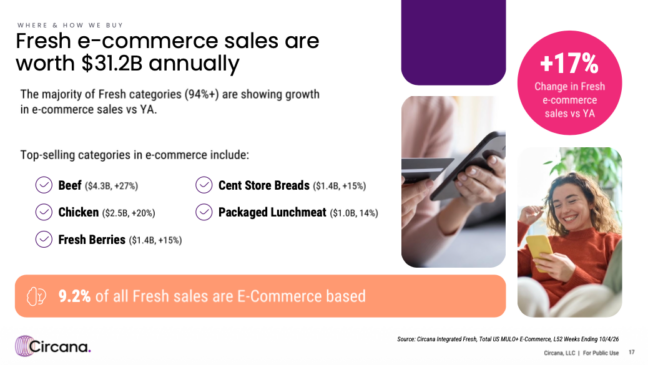
Online sales accounted for 39.6 percent of fresh dollar growth so far this year, the largest contribution of any channel, ahead of club at 24 percent and mass at 19.5 percent. Fresh e-commerce sales total $31.2 billion a year, up 17 percent, and represent 9.2 percent of all fresh sales.
Parker said fresh versions of staples can be tough to find online, where shoppers are often served CPG versions instead, and she added there is not enough suggestive selling of fresh foods that go together.
According to FMI research, 27 percent of shoppers now use AI at least once a week, up from 19 percent a year ago. Among shoppers who celebrate at least one holiday, 65 percent would like AI to help with holiday meal plans.
“AI is not going to replace the fresh experience. However, it will help shape how that shopper discovers the product, how they plan it and how they choose the experience that goes along with that,” Haaf said.
Department performance
Calendar year-to-date through Sept. 27, grocery dollars, which include center store and frozen, rose 3.9 percent with flat units. Perishable dollars rose 0.3 percent, while units fell 0.4 percent.
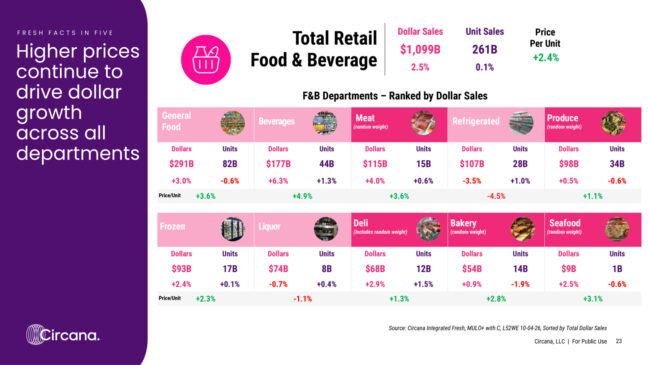 Over the 52 weeks ending Oct. 4, meat ranked as the No. 3 department in the store at $115 billion. Meat dollars rose 4 percent and units rose 0.6 percent, even as price per unit climbed 3.6 percent. Trip frequency fell in every fresh department except meat and seafood.
Deli dollars rose 2.9 percent to $68 billion, and units rose 1.5 percent. “Deli has really been a hero story of the reshaping of what consumers expect from U.S. food retail,” Parker said.
Bakery dollars rose 0.9 percent, but units fell 1.9 percent as price per unit climbed 2.8 percent. Parker said bakery price increases meant to protect margin are eroding shopper engagement, household penetration and trip frequency.
According to FMI’s Power of In-Store Bakery 2026 research, about 70 percent of bakery shoppers under age 45 want their in-store bakery to offer cultural and ethnic items, yet fewer than half say their local store’s bakery offers the assortment they seek. Haaf recommended using loyalty data to tailor assortment store by store.
In addition, kiwis, avocados, recipe-ready deli prepared chicken, sushi and sweet potatoes drove unit growth in their categories. Parker said kiwis posted double-digit growth in pounds, driven by younger consumers eating them for magnesium and other benefits.
Produce still recovering
Produce dollars rose 0.5 percent over the 52 weeks to $98 billion, but units fell 0.6 percent. In October, produce units were down 4 percent from a year ago, and greens and salads were down 13.3 percent, following this summer’s Cyclospora outbreak news. More than 40 fresh produce subcategories showed sustained sales declines this summer, along with companion categories such as dressings, deli salads and toppings.
Recall awareness has eased. In August, 83 percent of primary shoppers said they had heard about recalls or safety concerns involving fresh foods in the previous few weeks, compared with 53 percent in October.
In Circana’s October survey, 12 percent of shoppers said they do not expect to return to their previous packaged salad and leafy green purchasing. Fourteen percent said they cut back and plan to start buying again soon, and 19 percent said they have returned in part. Twelve percent said they have returned to prior levels, and 22 percent never cut back.
Parker said the industry responded with deep discounts, including 50-cent and $1 promotions. “In fact, we started to train them that the only reason to buy salads and leafy greens was because it was cheaper than other alternatives,” she said.
A third of shoppers want more information from produce brands or retailers about safety practices, where products are grown and recalls.
Meal solutions over silos
According to FMI’s Power of Foodservice at Retail 2026 research, 63 percent of shoppers are interested in deli meal deals or bundles with two or more items, and 61 percent are interested in heat-and-eat side dishes.
“Prepared foods can be more than just a department, and we need to think of them as more than just a department and a total meal solution,” Haaf said.
On promotions, he said “the next generation of promotion is not simply more offers, but it’s really about more relevant value.”
Circana’s National Eating Trends data shows 72.3 percent of main meals take 30 minutes or less to prepare, and half of in-home dinners are ready in under 15 minutes.
Younger shoppers drive the holidays
According to Circana’s annual holiday survey, 48 percent of parents, 44 percent of Gen Z shoppers and 42 percent of Millennials plan to spend more this holiday season, compared with 29 percent of all shoppers and 11 percent of Baby Boomers.
Krumholz said Boomers are passing the holiday reins to their Millennial children, but price pressure will shape the season. Among shoppers expecting higher prices from tariffs, 30.1 percent plan to take advantage of sales and deals, and 29.4 percent plan to buy fewer items. She said Thanksgiving bundles that feed 10 for $35 or $45 point to a competitive season.
Fifty-eight percent of consumers will not travel this holiday season. Twenty-four percent say some of their at-home holiday meals will be ordered precooked from a restaurant or grocery store, up 2 points from last year.
Fresh still anchors Thanksgiving, with 68 percent of those who celebrate planning to serve turkey, according to FMI’s U.S. Grocery Shopper Trends 2026. Gen Z and Millennial shoppers, as well as Black and Hispanic shoppers, are more inclined to replace traditional fare with alternate proteins and vegetables.
Looking ahead
Circana’s 2027 outlook identifies six forces:
- price-led growth with shrinking demand;
- tariff and input-cost volatility;
- value-seeking consumers;
- intensifying income and demographic polarization;
- wellness and GLP-1 drugs reshaping demand; and
- the growing relevance of digital-first and agentic commerce.
Parker said about 30 percent of U.S. households are on a GLP-1 drug, and another 37 percent are considering one or have used one in the past.
“When more than half of the U.S. population is taking measures to curb their appetite, they’re being much more intentional and different with how they’re approaching food and beverage,” she said.
Haaf said 41 percent of store dollars still come from fresh, citing FMI’s State of Fresh research.
“I do think the shopper is asking fresh to work harder and deliver clearer value, greater convenience and relevant choices,” he said. “Organizations that translate these shifts, keep things simpler, more flexible and more personalized are going to win at fresh and going to win the total solution as we move forward into the next year.”