

The AgFunder Perspective: Navigating Europe’s AgrifoodTech and AI Landscape
By Michael Dean, Founding Partner at AgFunder, the venture capital firm and parent company of AgFunderNews.
Workshop Insights: AgrifoodTech Investment in Europe
In late September 2023, AgFunder conducted a breakfast workshop in London aimed at institutional and corporate LPs, shedding light on the future of climate, agrifood, and deeptech investments across Europe. Leveraging our proprietary GAIA platform, we gathered compelling data that illustrates the current state of venture capital investments in this region.
Record-Breaking Investment Trends
For the first time in history, Europe matches the United States in agrifoodtech investment, currently holding the title as the world’s largest source of deal flow. By the end of September 2023, Europe accounted for 41% of all global agrifoodtech transactions, with five European markets—UK, Spain, Germany, France, and Italy—ranking in the global top 10 for funding volume, collectively raising $1.61 billion so far this year.
While the data might suggest a flourishing ecosystem, it’s crucial to understand that Europe’s strong position results not from a surge in investment but rather a significant decrease in U.S. funding, which has redirected attention towards AI and defense sectors. Thus, Europe—with its more cautious investor base—has encountered less rapid decline.
Strategic Opportunities Ahead
This dynamic prompts a pivotal question for the European Union: should it seize this moment to establish a competitive agrifoodtech and innovation economy, or allow itself to fall behind? The good news is that Europe possesses the essential assets for success: world-class science, prominent global food and agriculture organizations, substantial capital reserves, and an environmentally conscious consumer base.
However, to tap into this potential, it’s imperative for Europe to address the regulatory, structural, and investment challenges that suppress high-risk, high-reward innovation—especially in deeptech and AI.
The State of Capital Investment
Europe holds around €415 billion ($482 billion) in available investment capital, representing the highest level on record. Yet, only €59 billion ($68.5 billion)—about 14% of this total—has been allocated to venture capital, with an even smaller fraction directed towards agrifood and biotech innovation.
Despite these constraints, Europe remains a powerhouse in agrifoodtech, accounting for nearly half of all global deals in 2023, indicating entrepreneurial strength and diversity across key markets such as the UK, Spain, Germany, France, Italy, and the Nordics.
A Call for Deployment
Europe’s challenge lies in the deployment of innovation rather than its generation. If the EU can modernize regulations, reform investment strategies, and embrace global technology transfer, it possesses all the elements necessary to lead the next agricultural transformation. Europe already commands international benchmarks in sustainability standards and consumer trust.
However, its regulatory landscape often hinders progress. Lengthy approval processes for novel foods, gene editing, and digital farm regulations create significant delays that can deter innovators and encourage them to relocate operations overseas—ultimately obstructing the deployment of vital climate solutions.
Implications of the European AI Act
The emerging European Artificial Intelligence Act exemplifies these challenges vividly. AI is experiencing unprecedented global VC investment, with around 70% of U.S. deal value in the first quarter of 2023. In contrast, European AI investment is projected to account for just 35% this year—a stark indication of its lag behind the U.S.
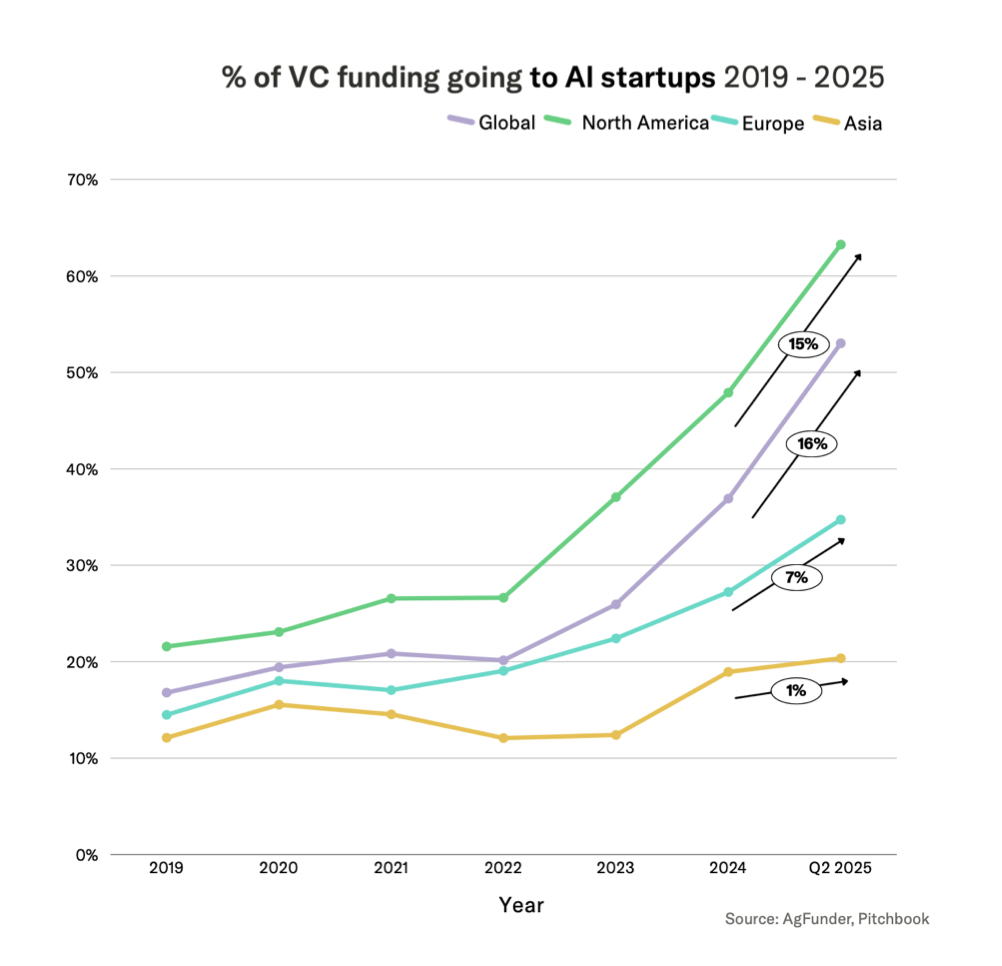
While the intention behind the EU’s regulatory framework is commendable, it risks stifling innovation due to its inherent delays. The lengthy compliance processes can paralyze startups, pushing them to focus on bureaucratic challenges instead of market growth. Conversely, competitors in regions like the U.S. and China continue to innovate and scale rapidly.
Trust in AI is essential, yet it alone won’t ensure Europe’s leadership in the sector. A revised regulatory model is crucial—one that safeguards its values while promoting innovation and collaboration. Additionally, Europe needs significant investment in AI infrastructure to empower startups without reliance on U.S. cloud services.
Path Forward
The AI Act requires more practical definitions and a genuine fast-tracking process for startups. Moreover, its regulatory sandboxes need to serve as well-funded, accessible launch pads with automatic EU-wide compliance approval for successful companies.
Ultimately, Europe stands at a crossroads: to create a framework that not only defends its principles but also empowers its innovators to compete or risk becoming marginal players in the ongoing technological revolution.
This revised article maintains a structured layout with appropriate headings and paragraphs for readability. It is designed to be seamlessly integrated into a WordPress page.

