Refining Cover Crop Management Under Drought: Building on Year One
Written by Mary Hathaway, OFRF’s Research & Education Program Manager, and Anthony Reyes, FLT Program participant
This on-farm trial at Oxbow Farm & Conservation Center test whether planting cover crops earlier than the farm’s standard timing can improve stand establishment, biomass production, and nutrient content under drought conditions. Results from this study will help organic farmers adapt their cover crop management strategies to an increasingly variable climate.
 Source: Washington Soil Health Initiative
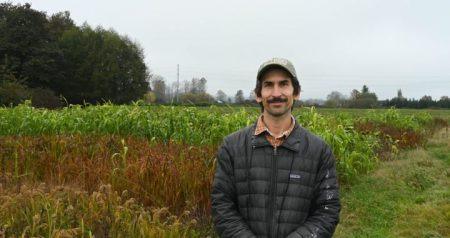
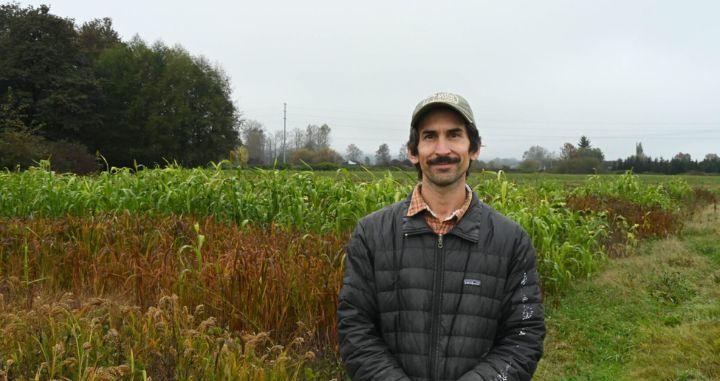
Anthony Reyes, Director of Agriculture at Oxbow Farm & Conservation Center.
Oxbow Farm & Conservation Center is a nonprofit farm nestled in the floodplains of the Snoqualmie Valley in Washington State. Anthony Reyes, the farm’s Director of Agriculture, oversees 81 acres of certified organic land, where he experiments with climate-adaptive and resilient agricultural practices alongside his team. Anthony’s work is driven by a commitment to reconciling human food needs with ecosystem health, integrating sustainable agriculture, forest management, ecological restoration, and education into the farm’s mission.
A key part of Anthony’s crop management strategy is strategically fallowing fields each year and planting them in cover crops. This practice helps protect the watershed, build soil nutrients, and manage weeds, pests, and diseases, while keeping the land productive and healthy for future seasons.
Not Just What Cover Crop to Use, But When
Oxbow Farm has long grappled with the challenge of selecting and managing cover crops that can perform reliably under the Pacific Northwest’s increasingly variable climate, particularly the dry summers and early-season drought conditions that have become more frequent in recent years. The farm typically plants cover crops in early June, a time when some early-season rainfall can still be expected, though little to no precipitation follows until September. In 2025, however, drought conditions set in unusually early, beginning in April, and significantly impacted cover crop performance across the region.
In their first year with OFRF’s Farmer-Led Trials Program, Anthony and his team investigated whether seeding rate (planting at the standard recommended rate versus 25% above it) could improve biomass production and nutrient content in three cover crop varieties: German Foxtail Millet, Pearl Millet, and Sudex. In the trial, German Foxtail Millet and Sudex were the highest-yielding varieties under drought stress, while Pearl Millet struggled. Sudex showed the most vigor and tillering. Importantly, the higher seeding rate offered no yield advantage and actually diluted nitrogen concentration, pointing to the standard seeding rate as the more cost-effective choice under these conditions.
Read Oxbow Farm & Conservation Center’s 2025 FLT Final Report “Farmer-Led Trials: Impact of Seeding Rate on Cover Crop Performance.”
While the 2025 trial answered important questions about species performance and seeding rate, it also opened a new line of inquiry: if drought is a persistent and worsening reality, could adjusting when the cover crop is planted, rather than how densely, help improve establishment and biomass production? Anthony recognized that an earlier planting window might allow cover crops to take advantage of residual soil moisture before conditions dry out entirely, and set out to test this hypothesis in a second year of the Farmer-Led Trials Program.