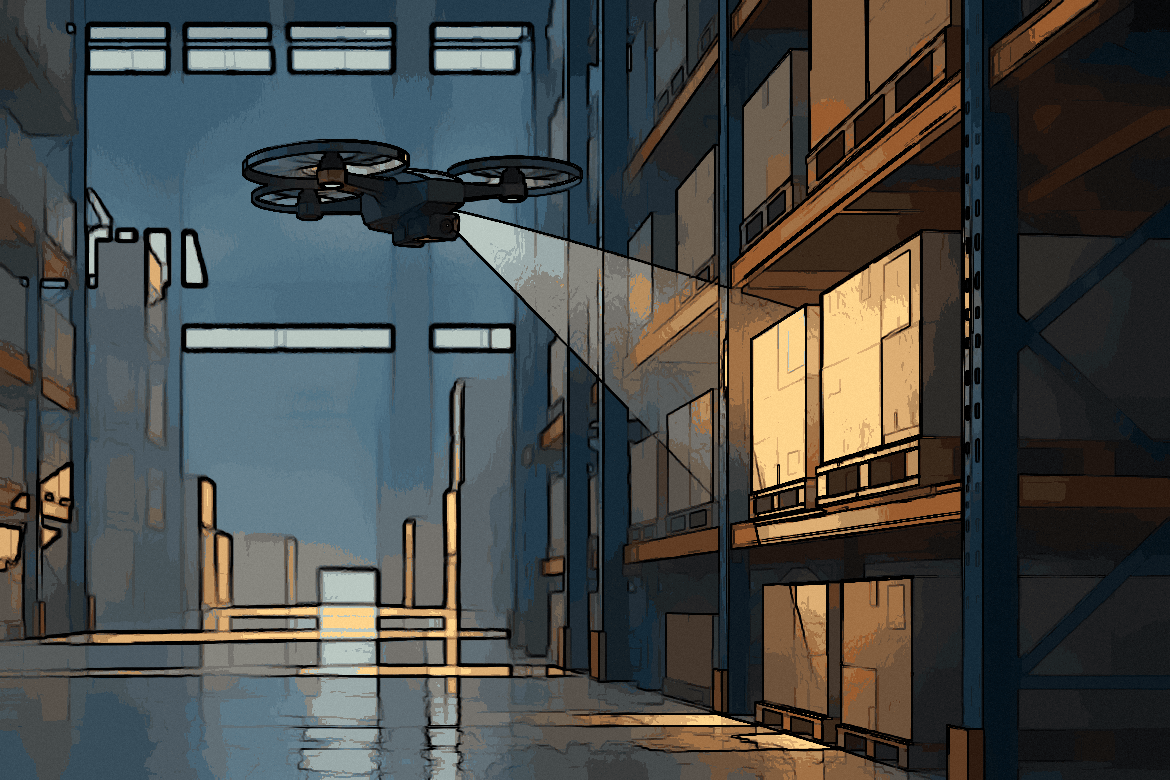
Supply chains are often becoming more and more data-centric. As warehouses seek to understand what they can know about their operations, they are employing warehouse management systems (WMS), enterprise resource planning (ERP) systems, barcode systems, sensors, camera systems, and automation solutions. A new relatively unexplored source of data that can be used by autonomous systems is data collected by drones.
More information doesn’t always lead to better decisions.
My own preference is that “What can the drone see?” is not the most interesting question anymore. The more relevant question these days seems to be, “How does that information get to the people and systems that can do something about it?”
A useful workflow can be viewed as:
Data Collection → AI Analysis → System Integration → Human Verification → Operational Action
Data Collection Is Only the Beginning
An appropriately equipped drone can become a mobile means of collecting data. Based on the application and the environment where the UAVs are deployed, they can collect images, videos, locational information, or other sensor data by performing repeatable missions. For instance, in the case of warehouse operations, a repeatable mission will help make observations about storage spaces or inventory storage locations. For larger logistics operations, something similar will be possible to perform then. Instead of treating each mission independently, organizations can collect data sets to compare conditions over time.
Nevertheless, it creates an additional challenge – the more missions performed, the more data collected.
In the absence of an efficient way to analyze this data, autonomous monitoring becomes simply a move of the problem from physical inspections to analysis of digital information.
Using AI to Identify What Matters
This is where AI-assisted analysis comes in handy.
Instead of having to manually comb through all of the images or observations, computer vision and machine-learning algorithms could be used to filter through the information that has been gathered, looking for certain patterns or imagery.
An algorithm could be used to reduce a broad set of information to a smaller, more manageable set of information and observations that are likely to warrant further investigation.
For instance, instead of hundreds or thousands of observations to look through, an operator could have a set of potential outliers to investigate. That is a different kind of automation, but the result is a reduction in the amount of routine information that needs to be manually reviewed.
Connecting Drone Data With WMS and ERP Workflows
Identifying an exception is useful, but an isolated alert has limited operational value.
For drone-derived information to become part of a supply chain workflow, autonomous inventory monitoring may need to connect with existing business systems such as WMS or ERP platforms.
Think about this example. A drone picks up a possible discrepancy for a storage location. If that observation exists solely within the drone platform, a human needs to look up what inventory should be present, find the record, and decide what to do next.
It might also be beneficial for the workflow to be more tightly coupled and link the observation to the location, inventory record, task, or operational process.
This principle makes sense: let’s not have drone data just be another data silo.
Integration enables aerial or mobile observations to serve as additional context to the systems that employees are already using to manage their operations.
Human Verification Still Matters
AI can recognize patterns and even potential outliers, but spotting the difference between an atypical occurrence and an actual one is an entirely different task. A changed condition may be an actual inventory discrepancy, but it can also be the result of a scheduled transfer, temporary staging, maintenance work, or any number of other occurrences.
That is why I think that human verification is a necessary component of any autonomous inventory-monitoring system.
A possible implementation could be something like this:
- Drone Detection – Captures operational data.
- AI Screening – Identifies potential exceptions.
- System Flagging – Prioritizes relevant findings.
- Human Verification – Confirms the detected issue.
- Operational Response – Turns findings into action.
The technology would handle the monotonous collection and screening of the data, while people would provide the actual operational context and decide on the resolution of the discrepancy.

Turning Insights Into Operational Action
At the end of the day, the value of an autonomous monitoring system lies in what comes next after the observation is made. Has this information helped solve an inventory mystery? Has it guided an employee to a place that needs investigation? Has it cut back on redundant checks? Has it provided information fast enough to affect a decision?
This shifts the focus of the conversation from drones themselves to actual workflow results.
Identify what information you need, what makes it an exception, where the gathered information goes, who verifies the information, and what is done after verification.
That turns something into a measurable workflow process and not just another tool added to the process.
Closing the Gap
Autonomous drones are likely to serve as useful data-collection tools in supply chain settings, but their true value will go beyond simply their flight capabilities.
The greater promise is to link mobile data collection, AI-enabled analysis, current supply chain infrastructure, and human knowledge in a single repeatable workflow.
But as these systems develop, I think that the most relevant question supply chain managers are going to start asking is not how much data autonomous systems can generate.
So, it is the degree to which we can convert that information into a validated decision and then into an operational action.
About the author
Andrew Mabry, a UAV technology researcher at ZenaDrone, specializing in drone technology, artificial intelligence, autonomous systems, and emerging digital technologies. His work focuses on practical UAV applications across industrial and commercial environments.