write a new articles with
Microalgae used for stock feed supplement trials being produced in pondage systems near Bowen in North Queensland
A RECENT article published on Beef Central about a commercial cattle supplementation trial in Central Queensland using farmed algae to limit winter weight loss in grower cattle has sparked a host of reader questions.
Supplier of grinding meat to the McDonald’s global burger restaurant network, Fulton Marketing Group (FMG Global), is one of the backers of the trial.
Research work based on the prospects to use farmed algae as potential stockfeed supplement can be traced back as far as 2014.
“AlgaeFeed provides an ideal stock feed supplement as it is simple to administer for both feedlot and grazing animals as it is administered through water troughs. University studies have also demonstrated that AlgaeFeed reduces ‘in-vitro’ enteric methane emissions by 25,” the company said.
The field trial involving 200 steers on Mountain View Grazing’s property last winter was monitored using Optiweigh in-field weighing systems. The trial identified that the non-supplemented control group lost weight on average at -0.7kg per head per day over the three-month trial period, while the AlgaeFeed supplemented cattle gained at + 0.1kg per day – a difference of 0.8kg.
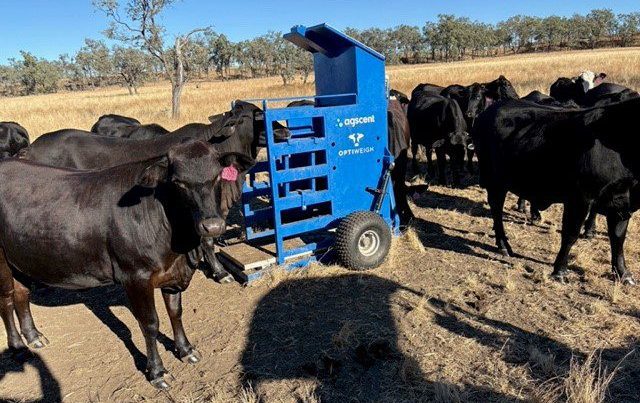
Q: The pictures on the Genesis site show a liquid being poured into a trough. The article says it is simple to administer for both feedlot and grazing animals as it is administered through water. Is it sold as a liquid product, a powder concentrate that is mixed with water or a dry product and how was it fed at Mountain View?
A: The product is a concentrated liquid formulation designed for delivery through standard livestock watering systems, and in some cases applied over dry feed. At Mountain View, it was administered via the water system.
Q: If it is sold as a liquid product, we also need the density (kg/L) to do nutritional calculations and costings.
A: AlgaeFeed functions as a biological stimulant rather than a conventional feed supplement. It works by supporting rumen microbial activity, which in turn improves the animal’s ability to extract nutrients from its existing feed base. As such, it is used at low inclusion rates and is not intended to replace protein or energy inputs in the diet.
The dried microalgae biomass typically has a crude protein content of approximately 50pc on a dry matter basis. However, this is not reflective of the product’s role or performance in use, given its function is not as a direct protein supplement. Its impact is instead observed through improved feed efficiency, where animals are able to derive more value from the forage or ration already being consumed.
Cattle consume between 3 and 6mls of concentrated algae per head per day (1:200 concentrate). Each concentrated mL contains approximately 10 billion algae cells.
Q: What is the product analysis? A protein content of 50pc is mentioned, is that on a dry matter or as fed basis?
A: When the algae is dried it is more than 50pc protein.
Q: The weightgain data quoted is a bit confusing. Non-supplemented animals were quoted as losing 0.7 kg per day whereas the supplemented animals gained 0.1 kg per day, a difference of 0.8 kg per day. Over three months the non supplemented group lost an average of 12.51 kg. Over 90 days this is only a loss of 0.139 kg per day versus the 0.7 kg per day loss quoted. Could you provide further clarity around the class of animals, time period, time of year and average starting and ending liveweights?
A: Performance outcomes reflect real-world management conditions over the course of the trial. The control group began the trial without supplementation under seasonal pasture stress, and later in the period, standard dry lick supplementation was introduced as part of normal herd management practice. This shift in management conditions is reflected in the overall blended results reported.
The trial involved a mix of Brangus and Brafords, run over a three-month period, from mid-May to mid-August 2025. Initial liveweights ranged from 284kg to 558kg.
Q: If cattle are losing 0.7 kg per day on dry season feed they can only be brought up to maintenance by feeding a large amount of energy which requires a high energy feed. Would be good to know the metabolisable energy (ME) of the product and whether the value quoted is on a dry matter or as fed basis.
A: AlgaeFeed is not designed to function as a primary energy supplement, and its metabolisable energy (ME) contribution is relatively low compared to conventional high-energy feeds. Any ME value would be expressed on a dry matter basis, however due to the low inclusion rate, it does not materially contribute to total dietary energy intake.
Instead, AlgaeFeed acts as a biological stimulant, supporting rumen microbial activity and improving nutrient utilisation. This enables cattle to extract more usable energy and protein from the existing feed base, which can result in improved feed efficiency and liveweight performance, even under low-quality dry season conditions.
In practical terms, the product is not replacing the need for energy in the diet, but rather improving the efficiency with which available energy is utilised, which is why performance improvements can be observed without the addition of large quantities of supplementary feed.
into a unique and well structured article. Ensure the new content is plagiarism-free, well-organized, and formatted for seamless integration into WordPress. Use appropriate HTML tags (e.g.,
,
,
) and enhance readability with proper formatting