South Korea Leads Agricultural Transformation with AI Integration
South Korea has recently rolled out ambitious plans to incorporate artificial intelligence (AI) into its agricultural sector, joining a wave of initiatives from countries such as India, the UAE, and Saudi Arabia. These efforts aim to help farmers adapt to challenges posed by climate change, geopolitical conflicts, trade tensions, and unstable supply chains.
Introducing the Agriculture and Rural AI Transformation Strategy
The cornerstone of South Korea’s ambitions is the Agriculture and Rural Artificial Intelligence Transformation (AX) strategy, co-announced by the Ministry of Agriculture, Food and Rural Affairs and the Ministry of Science and ICT. The strategy seeks to democratize access to AI technologies for farmers of all scales, from small and medium-sized enterprises to large commercial farms.
The plan includes the establishment of shared machinery centers, smart processing hubs, and AI-assisted livestock grading tools. Agriculture Minister Song Mi-ryung emphasized, “AI is no longer a choice but a core foundation that will determine the survival and future competitiveness of agriculture and rural communities.” The minister aims for 2026 to be the launchpad for agricultural AX, targeted at overcoming serious challenges like climate change and an aging population.
Broader Economic Vision
South Korea’s aspirations extend beyond merely transforming agriculture. The country envisions becoming a top global biotech economy by 2030. Earlier in the year, it announced plans to merge the National Bio Committee and the Biohealth Innovation Committee to further stimulate growth in biotechnology.
Additionally, Samsung Biologics recently unveiled a collaboration with Eli Lilly to set up a hub to support nascent biotech firms, further enhancing South Korea’s biotechnology landscape.
The Need for Efficiency
With only 22% of South Korea’s land available for farming, there’s an urgent need for more efficient agricultural practices. This highlights the importance of technology, including microbiome innovations for crop protection and AI tools aimed at creating stability within variable supply chains.
A Shift in Agrifoodtech Funding
Reflecting these trends, funding in the agrifoodtech sector in South Korea is increasingly focused on upstream solutions. According to AgFunder’s Global AgriFoodTech Investment report, approximately $120 million was allocated to startups engaged in agricultural innovation and supply chain enhancements, while $96 million targeted downstream sectors, such as food delivery and restaurants.
The significance of AI and robotics is permeating various investment categories, whether on farms or in culinary settings. Notably, 40% of last year’s funding was attributed to a Series C round from GINT, a company specializing in autonomous agricultural technology. They have expanded their offerings to include AI-driven crop management and robotic pest control systems.
Investment Landscape
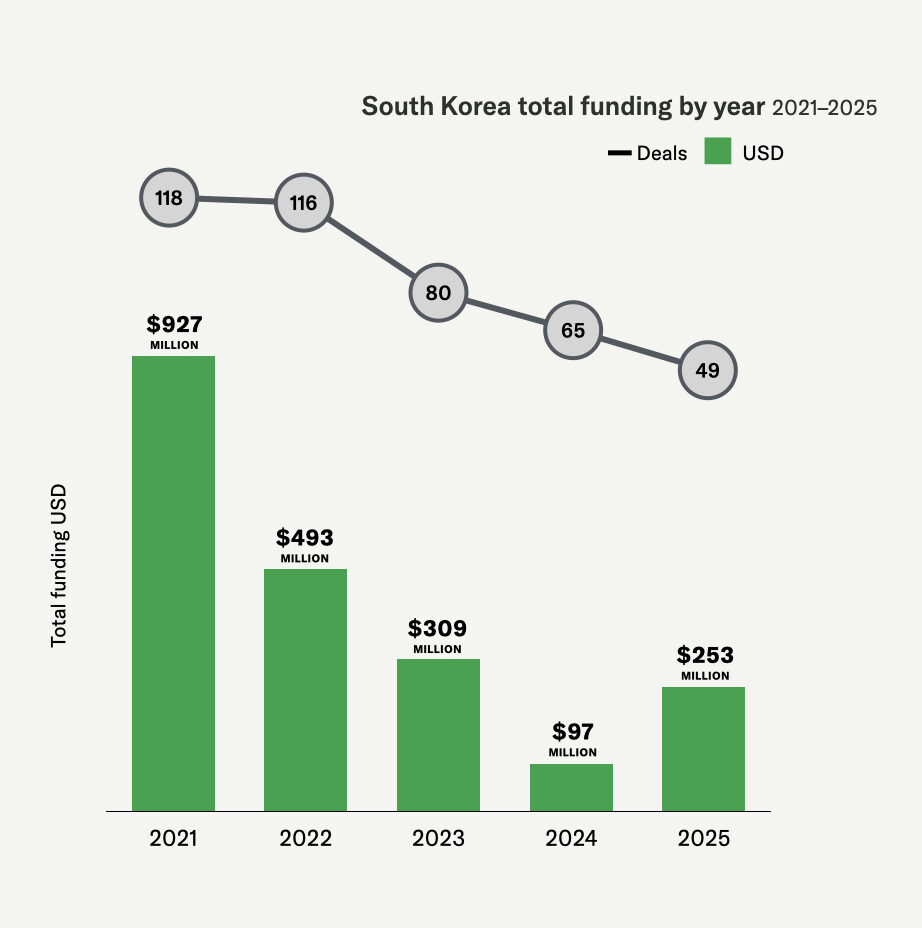
The overall agrifoodtech investment in South Korean startups has seen remarkable growth, soaring from $97 million to $253 million in 2025. However, the number of deals has decreased from 65 to 49, highlighting a cautious approach within the broader agrifood ecosystem.
Currently, 82% of funding deals are concentrated in Seed or early-stage companies, with a median deal size of just $4.1 million. This aligns with global trends, as the proportion of first-time funding rounds has risen to 46% after years of decline in the sector.
The Road Ahead
For South Korea, the pressing question remains whether these startups can secure the requisite follow-on funding and if the nation’s efforts to integrate AI and deep technology will catalyze growth in the agrifoodtech landscape.