


I’ve spent more than 20 years in grocery retail, and if there’s one thing I’ve learned, it’s that doing nothing is still a decision. And in today’s grocery environment, it may be one of the most expensive decisions a retailer can make.
We operate in an industry where pennies matter. Labor is tightening, wages are rising, inflation continues to pressure operating costs, and margins leave little room for error. Yet many retailers continue to manage their fresh departments with the same processes, spreadsheets, and gut instincts they’ve relied on for decades.
Experience matters. I wouldn’t trade my years on the sales floor for anything. But experience alone can’t process the thousands of variables affecting today’s stores.
And that’s where operational AI changes the equation.
The Executive Cost: Standing Still Isn’t Standing Still
At the executive level, hesitation often comes from reasonable concerns. Will it integrate? Will our people use it? What’s the return? Is the technology ready?
Those are fair questions. But there’s another question that deserves equal attention:
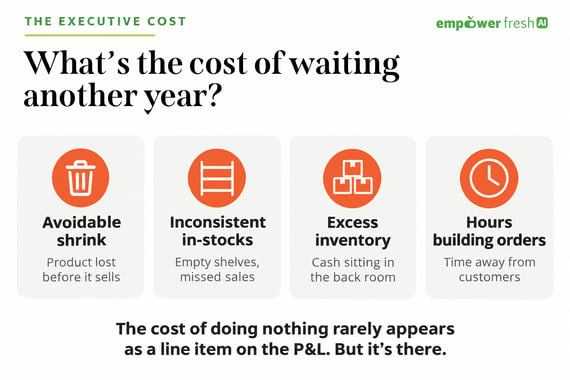
What’s the cost of waiting another year?
If your current processes are producing 3% avoidable shrink, inconsistent in-stocks, excessive inventory, and managers spending hours building orders, waiting doesn’t preserve your position. It guarantees more of the same.
Actually, it may be worse.
As labor becomes more expensive and experienced department managers become harder to find, yesterday’s operating model becomes increasingly difficult to sustain.
Every month of indecision is another month of missed margin opportunities, unnecessary waste, and labor hours that could have been redirected toward customers and sales.
The cost of doing nothing rarely appears as a line item on the P&L. But it’s there.
The Store-Level Cost: Falling Behind
There’s another side to adoption that executives sometimes underestimate: the store floor.
I’ve worked with outstanding department managers who know their business inside and out. They can walk a produce department and tell you what’s selling, what’s struggling, and what needs attention.
But even the best manager has limitations.
When one store embraces AI-driven forecasting, ordering, and inventory management while another continues operating manually, the difference begins to compound.
One manager spends less time calculating orders and more time merchandising. One store identifies potential shrink before it becomes a loss. One team has better visibility into what’s actually driving profitability.
Meanwhile, the store resisting change is working just as hard, perhaps harder, to achieve yesterday’s results.
AI doesn’t replace a great department manager. It gives that manager an advantage.
And over time, that advantage becomes difficult to overcome.

The Real Risk Is Not Changing
Grocery retail has never been an industry that rewards complacency. We’ve adapted to scanning, automated replenishment, digital advertising, and countless other operational changes.
AI is the next evolution, but its impact may be greater because it touches decisions we make every single day.
The retailers who win won’t necessarily be those with the biggest budgets or the most stores. They’ll be the ones who recognize that operational improvement can no longer wait.
And the best part is, the cost of integrating AI is less than you expect, comparable to a few cases of product saved! ROI starts instantly.
The question isn’t whether you can afford to adopt operational AI. It’s how much longer you can afford not to.
EmpowerFresh AI. Helping independent grocers turn better decisions into better results.
By Jesse Himango, COO at EmpowerFresh AI
What is waiting on operational AI costing your stores?
See what operational AI built for independent retailers can look like in your stores.
Contact EmpowerFresh AI
(function(d, s, id) {
var js, fjs = d.getElementsByTagName(s)[0];
if (d.getElementById(id)) return;
js = d.createElement(s); js.id = id;
js.src = “//connect.facebook.net/en_US/sdk.js#xfbml=1&version=v3.0”;
fjs.parentNode.insertBefore(js, fjs);
}(document, ‘script’, ‘facebook-jssdk’));