
write a new articles with
The Market Changed. Marketing Has To Change Too.
Ag marketers are being asked tougher questions than they were just a few years ago. Budgets are tighter, finance teams want proof of impact, AI is accelerating campaign execution and the data infrastructure many marketers relied on is becoming less reliable. The result is a new reality: digital performance can no longer be judged by reach, clicks and impressions alone. Success increasingly depends on the quality of the signals behind every marketing decision.
The Market Reality: What’s Changed and Why It Matters Now
Several forces are converging at once. Farm budgets are under pressure. U.S. farm sector debt is projected to reach $624.7 billion in 2026, while commodity prices remain soft and input costs continue to rise. Every dollar spent across the value chain is being scrutinized more closely than ever.
At the same time, cookie deprecation and privacy changes continue to erode the effectiveness of traditional audience targeting. Nearly 90% of marketers have shifted toward first-party and zero-party data strategies, while fewer brands view cookies as a long-term solution. For years, third-party cookies felt like a permanent fixture of digital marketing. Then came the privacy regulations, browser changes, and growing consumer expectations that flipped the script. Google paused its plan to fully phase out third-party cookies in Chrome, opting instead to introduce new user privacy controls — but don’t let that fool you into thinking the pressure is off. The direction of travel hasn’t changed, only the timeline.
Meanwhile, the measurement bar has been raised. Attribution alone is no longer enough. Incrementality, pipeline contribution and revenue impact are becoming the standard metrics leadership teams expect marketers to demonstrate. Nielsen reports that while 85% of marketers say they are confident measuring ROI, only 32% actually measure spend holistically across channels.

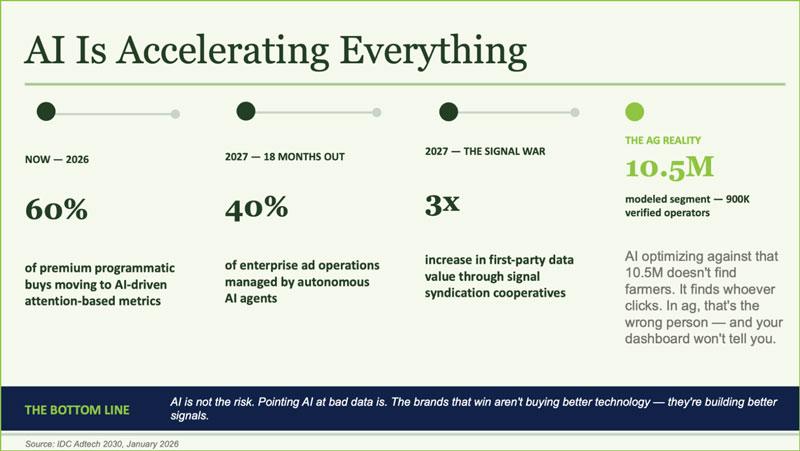
Then there is AI. AI is rapidly becoming embedded in media buying and optimization. But AI does not solve data problems. It accelerates them. The brands seeing the strongest results are not necessarily using better technology. They are building their AI strategy off of better signals.
The Signal Problem: Most Campaigns Are Broken Before a Single Impression Is Served
The challenge is not creative. It is not a budget. It is not AI. The challenge is often the signal set campaigns are built on.
Your Audience Is Probably Wrong
Many audience segments appear large and impressive on paper but fail under scrutiny.
One example from Farm Journal’s analysis compared a modeled third-party crop producer audience to a verified operator audience. The third-party segment contained approximately 12.6 million individuals. The verified operator audience contained roughly 983,000 actual operators. Scale and accuracy proved to be very different things.
This is not necessarily a vendor problem. It is a structural problem.
You Are Using the Wrong KPI
Many marketers still rely heavily on click-through rate because it is easy to measure and easy to report. The problem is that clicks rarely reflect how ag buyers actually make decisions.
According to Nielsen research, CTR showed less than 1% correlation with ad recall, brand awareness and purchase intent. A campaign can generate clicks without generating meaningful business impact. For products with long buying cycles, marketers need to pay closer attention to engagement quality, site behavior, audience movement and downstream outcomes.
AI Scales Whatever You Give It
AI is not magic. If campaigns are optimized for clicks, AI will find more people likely to click. If campaigns are built on weak audience signals, AI will optimize around weak audience signals. Faster optimization does not automatically create better performance. It simply scales whatever system already exists.

Third-Party Data Is Often Wrong in Both Directions
One of the most surprising findings from the above analysis was that third-party data does not consistently overstate audiences. Sometimes it understates them. Sometimes it misses them entirely. In one comparison, a third-party agriculture segment containing 10.5 million IDs shared zero overlap with a verified audience of 592,000 in-market machinery buyers. Not a small overlap. Zero.
The lesson is not that all third-party data is bad. The lesson is that all data deserves scrutiny.
The Advantage: Better Questions Create Better Results
Marketers should become more skeptical of every audience claim, every dashboard metric and every performance report.
Four questions can quickly reveal whether data will hold up when it matters:
1. Is the Audience Verified or Modeled?
Modeled data infers behavior. Verified data observes it. Knowing the difference determines whether you’re activating confirmed demand or making a guess about who might convert.
2. When Was the Data Refreshed?
Agricultural buying behavior changes with seasons, commodity prices and operation transitions. Data that was useful 18 months ago may no longer reflect who is actively in market today.
3. Does the Creative Match the Audience?
Even the best audience cannot overcome messaging that speaks to the wrong operation type, the wrong need or the wrong stage of the buying journey.
4. Are We Measuring Buyer Behavior or Dashboard Behavior?
Clicks may satisfy reporting requirements, but site quality, engagement depth, view-through activity and audience movement often provide a much clearer picture of actual buyer intent.
The Method. The Proof. Real Campaigns. Real Results.
The strongest campaigns consistently share four characteristics.
1. Verified Audiences – Start with real operators and real buying signals, not assumptions. Verified audiences provide a stronger foundation for targeting and optimization.
2. Context and Timing- Campaigns aligned to relevant agricultural content and seasonal buying windows consistently outperform broad placements. One Farm Journal analysis found contextually targeted display campaigns delivered a 79% higher CTR than run-of-network placements, while action-triggered emails to verified operators achieved a 35.65% open rate.
3. Creative Alignment- Different formats serve different stages of the buying journey. Video often performs best during research and awareness, while other formats support consideration and reinforcement. Creative should match buyer behavior, not internal production preferences.
4. Measurement That Matters- In a head-to-head test using identical creative and spend, audience quality was the only variable. Clicks were essentially equal between audiences. Yet the verified audience generated 106% more unique users and 341% more total site visits. If CTR had been the only metric measured, marketers would have missed the difference entirely.
The Market Has Shifted.
Budgets are tighter. AI is accelerating execution. Privacy changes continue. Leadership teams are demanding proof of business impact.
The marketers who succeed will not be those with the biggest audiences or the flashiest dashboards. They will be the ones building campaigns on better signals, asking harder questions and measuring what actually matters.
Better signals lead to better decisions. Better decisions lead to better results.
into a unique and well structured article. Ensure the new content is plagiarism-free, well-organized, and formatted for seamless integration into WordPress. Use appropriate HTML tags (e.g.,
,,
) and enhance readability with proper formatting

