by Clare Boland, OFRF Communication Manager
About Genesis Gardens
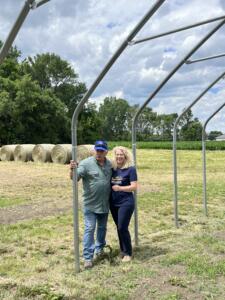
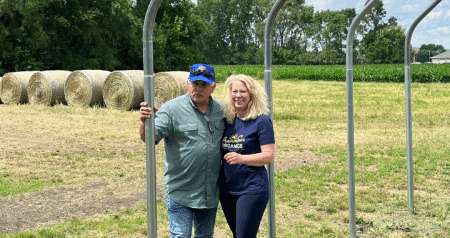
Glen Pulse, Genesis Gardens’ Operation Manager, and Dr. Angela Jackson-Pulse, SDSPA’s TOPP Organic Ag Transition Advisor.
In Vermillion, South Dakota, a committed group of volunteers is bringing an old conventional agriculture plot back to life. Genesis Gardens, a project of Pulse of Life Church, is working to create a community farm and kitchen on the land adjacent to the church, right outside Vermillion’s city center. The mission of the project is to use local, organic food production to nourish their community and create a meaningful connection to the land they steward.
In addition to committed volunteers, Genesis Garden is utilizing USDA grants to make their dream a reality. The first phase of the project is rebuilding soil health and establishing a community farm using regenerative practices. Through the Natural Resources Conservation Service (NRCS) Conservation Practice Standards 823 (Organic Management), the farm receives cost-share funding to do regular soil tests and create a soil management plan based on the results. The second phase is converting a shed on the property into a commercial kitchen, which will supply food for local schools and the community. Through the Resilient Food Systems Infrastructure (RFSI) program, Genesis Gardens is creating a kitchen for value-added processing of the produce they grow; the facility will also be available to local farmers in the area.
Farmer Glen Pulse, a co-owner of Prairieun Organics, serves as the garden’s operations manager. This past summer, OFRF visited Genesis Gardens for a soil health field day hosted by the South Dakota Specialty Producer’s Association. At the event, Glen described his work building soil health on the site, and local NRCS agents guided attendees through the process of completing soil tests, and shared how NRCS programs can benefit small-scale, organic producers.
Starting with the Soil
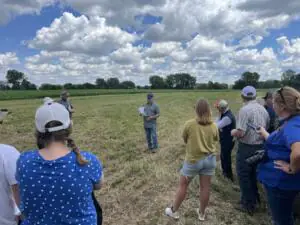
Glen explains Genesis Gardens’ soil health practices to field day attendees.
The biggest challenge for Genesis Gardens was rebuilding soil health. The land had been used to farm corn and soybeans conventionally for over 20 years, leaving the soil depleted. Glen and his wife, Angela Jackson-Pulse, have farmed at Prairiesun Organics since the 2010s, using exclusively regenerative organic practices since 2019. Following the lead of their farm, Glen’s goal at Genesis Gardens is to “use nature as nature intended, to rebuild things.”
To help rebuild, Glen first turned to his local NRCS office. There he was matched with Ryan Frickel, Clay County’s District Conservationist, who also attended the field day. Ryan worked with Glen to create a soil-testing and regenerative-practice plan for the farm under CPS 823 (Organic Management).
“823 works as an umbrella term,” Ryan explained. The standard facilitates cost-sharing and technical support for transitioning and organic producers pursuing organic practices like reduced tillage or no-till, nutrient management, soil testing, cover crops, cropping rotations, creating field borders, and more. “823 can handle all that under one interim conservation practice.”
>>> About NRCS CPS 823 (Organic Management): CPS 823 was an interim Conservation Practice Standard that NRCS offered through the Environmental Quality Incentives Program (EQIP) for transitioning and certified organic farmers. NRCS discontinued it starting in fiscal year 2027. Existing contracts can be carried through to completion, but no new CPS 823 contracts can be written.
The field day also gave attendees a hands-on look at why soil health matters. NRCS staff zeroed in on how regenerative soil health practices can help farmers and gardeners, using a rainfall simulator to show how quickly water infiltrated through five different soil plates: rotationally grazed, continuously grazed, cover crop, no-till, and conventional tillage. The no-till, rotationally grazed, and cover crop plates absorbed significantly more water, while conventional tillage had the most runoff. “The message is,” an NRCS agent shared, “it’s important to keep your soil covered.”
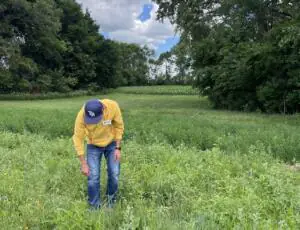
Ryan Frickel in Genesis Gardens’ pollinator habitat.
Later in the day, Ryan showed field day attendees how to measure water infiltration rate on their own land using a ring cylinder test.
Genesis Gardens’ three-year organic transition plan is rooted in listening to the soil. “[The land] is healing itself,” Angela said. “We let the soil tests and the soil analysis guide what we do on the land.” Year one started with a baseline Haney soil test, then a minimal tillage event to establish a cover crop, and then they let the land rest.
“You’ve been through a hard 30 years,” Angela said of the land, “I think you need a break.”
Through analyzing soil results and working with Ryan, Glen and Angela were able to tailor their cover crop mixes to the needs of the land. Where the land borders a conventional agricultural operation, they planned an herbicide-resistant cover crop seed. Where the land borders the road, they planted a salt-tolerant mix. They also planted a monarch mix to establish a pollinator habitat.
When we visited Genesis Gardens, it was in year two of the plan. The soil test at the end of the first year showed improved soil health, but that the land needed a little more time to rest in cover crop before moving into production. The plants in the pollinator habitat were just starting to show flowers and bring beneficial pollinators back to the land.
Working with NRCS
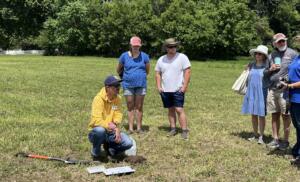
Ryan demonstrates a ring cylinder test.
To others looking to create a project like this, Glen said their first stop should be their local NRCS office. “It was as simple as giving our local NRCS agent a call, asking him a few questions, and that lit the spark.” If the local office doesn’t have the expertise needed, he encourages farmers to call around until they find an office that does.
Getting started with NRCS “can be a bit of a process,” Ryan shared. It will take a little while for a new farm to get in the system and enrolled in a program. Ryan encouraged farmers to do a bit of research into what organic practices they are interested in and how they contribute to the needs of their land. “You do always have to have a resource concern to justify the practices you want to use.”
Growing Good, Ground Up
The mission for Genesis Gardens mirrors the journey of its soil. “We’re taking something that’s depleted and turning it into something that’s giving life, in a healthy way,” Glen said.
Later that summer, Genesis Gardens established their first beds for vegetable crops. After preparing the initial beds, they aim to be as close to no-till as possible, utilizing strategies like creating mulch borders and weeding by hand.
In addition to rebuilding the soil, Genesis Gardens also plans to build community by connecting people to where their food comes from. This includes a kids’ garden education program, an “adopt a row program,” and free or reduced-price CSA shares for low-income families.
Glen is hopeful that this project can serve as “local research for what can be done with depleted soil” and inspire people to bring organic agriculture into their communities.