
Cattle Levy
There has been plenty of media about the Cattle levy review and the coming vote. I sat in on the presentation with Cattle Australia chair, Garry Edwards and must say the business plan and accountability structure is as good as I have seen.
The levy does not change unless reporting and return on investment requirements are implemented first. For too long producers have complained about where the levies go – well now is your opportunity to improve the structure. Fill out your voting form below and endorse a proxy for someone attending the MLA AGM or the CA chair.
Many other businesses should take the time to look at this plan because it is rare to see accountability used as a cornerstone in advance – well done. Votes must be lodged if not attending the MLA AGM by 22 November.
Chris Howie
Price transparency / Killarney sale
I note with a smile the Auctions Plus sale of the 4000 Killarney mixed sex cattle, last Friday week, covered in this Beef Central article.
Smart business from Callum Maclachlan and his team, well done to Paul McCormack, Elders for pulling it together. Often closed loop supply chains like live export, breed or brand aligned processor programs and intensive operations (direct consignment of bullocks, Wagyu, pork, weaner crocodiles, chickens) lose the ability of price discovery.
Auction may not be the overall business model, but every now and then testing the demand is smart. The Killarney sale highlights this – offered in a perfect parcel for live export it has allowed everyone a shot at the target.
All of a sudden, a price win with an unexpected buyer appears. When dealing in significant numbers (bullocks, lambs, cow, mutton), putting a sample run up for auction provides price discovery and creates market tension around supply and who wants them. Basic offer – the winning bid has first right to negotiate on the balance.
Cattle
I called into Dubbo two weeks ago and was amazed at the quality of the line up. Even though the Central NSW missed the rain vendors and agents saw the rain in other areas as an opportunity to capture price.
The entire yarding was in forward to prime condition with plenty of sap. Looking at market reports from Dubbo last week and a chat with Edwina Tink, Peter Milling & Co Dubbo the market has stayed very strong with quality cows over $4.20, feeders $5.60 – $5.80 and weaners very well sought with 200- 250kg models making around $6.50. These followed on from a line of 90 Santa weaner steers sold by AWN PT Lord, Dubbo the previous week which made $6.42 averaging about 285kg.
The further north we go the stronger it seems to get with a limited run of feeders at Dalby making $5.80 – $6.10 and one report that Roma young cattle “were off their chops” driven by rain and feed.
I dropped some comments into the below episode of The Week in Beef podcast from Dubbo:
Spot feedlot cattle
Speaking to several significant feedlot operations it has become apparent a number of spot price cattle, off feed (no contract in place) have come onto the market.
Lots of discussion around the expansion of the feedlot industry is being reported. However, the intricacies are often missed. The main growth has been processors vertically integrating to remove supply risk and existing feeders expanding capacity on long term forward contract arrangements or offering custom feed slots.
In turn this puts stability into pricing for cattle purchased x feed consumed etc etc. Spot cattle, in numbers tend to oversupply the grain programs and create downward pressure on grid prices because they appear without notice. Spot price has always been a percentage of any operation with opportunity to buy additional numbers if the feeder price drops quickly or for marketing overweights, but those fully exposed with no contract at all are in the high-risk paddock.
Is it best to transport the feed to the cattle or take the cattle to the feed?
Feedlot rations are also coming into play with the southern harvest rolling and barley playing in the $250-$260 range with plenty of hay, some rain damage also.
However further north the need for grain has seen some interest in the south aligned to proximity to rail. The cost to pull grain / hay north is now starting to make calculators work on what is more cost effective. Transport the feed to the cattle or take the cattle to the feed? Again, all of this moves towards opportunity in some areas that may not have existed before.
Just a little win for the books, definitely not 4000 head but the math still applies. A smaller NSW operation unloaded 10 cows 4-6 years with calf at foot not rejoined – $3800. They then stepped straight in and purchased 16 quality heifers for $1700 which have immediately met the bull. Money in the bank and more cattle, there are still opportunities.
Sheep and Lamb
US lamb hearing. With the lamb (sheep) prices in Australia steaming ahead a contingent of Australian lamb industry representatives has spent significant time in the US defending Australia’s position, along with other exporting countries to this important export destination.
Sheep Producers Australia CEO, Bonnie Skinner gave evidence – along with other Australian and US witnesses – at the US International Trade Commission’s (USITC) public hearing in Washington DC on 16 October, as part of the ongoing safeguard investigation into lamb imports.
A safeguard investigation examines whether increased imports are causing, or threaten to cause, serious injury to a domestic industry and whether temporary trade measures may be warranted. The investigation covers lamb imports from all countries, including Australia.
Sheep Producers Australia has been working closely with Meat & Livestock Australia, the Australian Meat Industry Council and legal advisers to support a coordinated Australian industry response.
Hopefully this time line helps the lambs producers understand what is happening as traders and processors are all in a catch 22 on how to price store lambs and what prices after Christmas will be based on.
The key dates in the investigation are:
- 13 July 2026: US Trade Representative (USTR) formally referred the matter to the US International Trade Commission (USITC). USITC initiates investigation under Sections 201 and 202 of the Trade Act of 1974. Completed
- July–August 2026: USITC issues questionnaires to US producers, importers and other relevant businesses. Completed
- August–September 2026: Questionnaire responses submitted and evidence prepared. Completed
- 8 October 2026: Deadline for pre-hearing briefs. Completed
- 16 October 2026: USITC public hearing on injury and threat of serious injury. Completed
- 23 October 2026: Deadline for post-hearing briefs. Completed
- 13 November 2026: USITC injury determination expected.
- 23 November 2026: Deadline for remedy pre-hearing briefs, if required.
- 1 December 2026: USITC remedy hearing, if required.
- 8 December 2026: Deadline for post-remedy briefs, if required.
- 11 January 2027: Deadline for USITC to submit its report and any recommendations to the US President.
- Following the USITC report: US President considers whether to impose safeguard measures, generally within 60 days of receiving the report.
Trading lambs. With a couple of weddings over the past month, I have talked to a lot of old clients and farmers from many of the sheep areas. All of them trade lambs on stubbles as part of their cropping program – some 500, some 10,000. Nearly 100 percent of them have said they will cut back or not trade at all this year because of the store lamb price. More than one told me” “I don’t need the practice and with the crops OK, a holiday is the better option.”
Future breeding ewes – the early resistance to market value of ewes seems to have disappeared. I attended the local first-cross ewe sale run by Ash Fawcett, Nutrien Mt Pleasant and watched well-presented 18-month-old first cross ewes consistently make $500-$540 and the best first cross ewe lambs make $462. No different to any auction, the first bid needs to be dug out, but once started, buyers bid with confidence on these program replacement ewes.
Luke Nevins, Principal of FP Nevins and Sons gave me a report for last Friday’s Bendigo Blue Ribbon ewe sale. With 22,000 yarded and averaging $462 across the lot it was a great sale with the buying strength presenting from the Gippsland and Western districts including Ballarat. Sorry to the Mt Pleasants record ewe lamb price as it only survived 2 days with Bendigo recording a top ewe lamb price of $595 and 9668 ewe lambs averaging $391.
The 1.5 year olds averaged a whopping $556 with tops of $620 over multiple pens. From my information Corowa 1.5 ewes keep the lollies with a $641 top. I hope McKean McGregor’s Lachy McAllister didn’t have a carton on which centre would ring the bell..
We will see the next in the series of first cross ewe sales this week with Edenhope and Naracoorte tomorrow. Year-on-year the quality of these sales is a highlighted with many repeat vendors and buyers.
Store lambs are now appearing in numbers with a mix of wooly and shorn across all southern centers barring the deep south. Price reports vary with Conor Lamond, Elders Roseworthy Livestock manager seeing SA stores prices easing by $10 – $15. Speaking to Geoff Rice, Hunter Schute Bell Rice and Co Parkes said Forbes store lambs remain fully firm with plenty of demand.
Geoff said “The apprehension around the lamb pricing after Christmas is now influencing decisions on whether to shear and feed on or take current money.”
Isaac Hill, Wagga Regional Livestock, quoted Thursdays Wagga sale as fully firm. However, if you take into consideration a bit more skin combined with second and third draft lambs the rate is probably a bit better on the quality but still ranging from $11.20 – $11.80.
One agent raised the fact it is rare to see the supermarket money behind some of the export grids. I have notice there was no spring lamb campaign this year from the supermarkets which has been a standard for a long time.
Seed contamination
The first seed contamination stories are starting to appear with the content between assessment of lambs and delivery changing dramatically. Barley grass in woolly lambs is fixed with a quick shearing but spear grass and corkscrew are the next level.
Some of the discussion become quite animated but common sense needs to prevail. Often that means hanging a lamb up to check for seed penetration prior to delivery to the processor. From Morgan in SA to Booligal is a sea of spear grass this year and fire will be the next concern.
Grass fever is here again
lets buy the stock because we have grass and work the sale price out later.
When lambs were $100 and weaners were $1000 your opportunity on weight gain could get you out of trouble, turning grass into a margin. However with weaners at $1800 and store lambs at $250, a 20pc price correction is an issue unless you have put some form of plan in place.
The only reason the ECYI has jumped 125c/kg in a month is grass and rain. No other reason. Store lambs have held rate well into November but are starting to soften now in some areas. Good feed, available funds – does not guarantee a positive margin at current prices.
Working capital
This spring we are already seeing working capital pressure appear across all participants of the livestock industry. Every B Double of stock equates to $220,000 to $240,000 compared to $140,000 – $160,000 last year.
Often the pressure within a business around working capital comes with the late payment from a buyer and can cause a domino effect. Making sure you have appropriate insurances in place, early conversations with your bank and deal with del credere agencies on livestock (you are paid irrespective of when the agent receives their funds) is a common-sense safe guard.
Fuel levy comparison
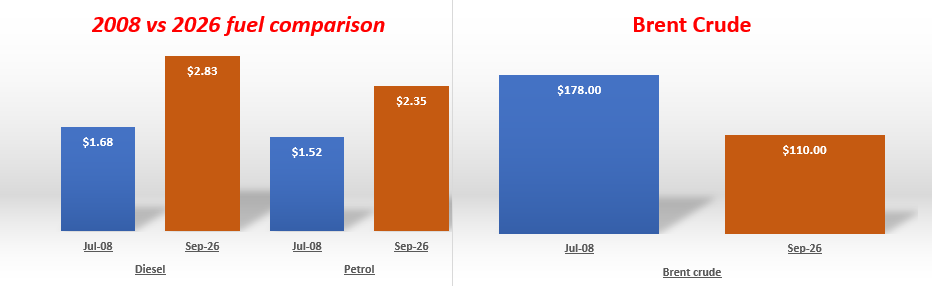
I found this comparison of 2008 to 2026 on our current fuel prices very interesting.
What is the difference? Very simple, we have lost sovereign fuel refining capacity. In 2008 we had eight refineries (nine with mothballed Port Stanvac). In 2026 we have two. If you are picking up what I am putting down, we have created this issue within Australia by allowing our refining capacity to be let go. For a country that can feed, fuel and supply itself we seem to be invested in letting other countries take the benefit.
Sale reports
Nearly every agent at every centre has a video market report on Facebook and it is very easy to tune in for a quick update. Some also give you a smile with the trail blazers Pat Cleary and Dhugald McDowell at Elders Cleary McDowall, Mossvale and Jack Kelly at J & J Kelly, Warrnambool / Mortlake adding a splash of humour to boot.
Opportunities
- When buying keep your finger on the pulse – Not all sales are big prices
- Weaning cattle, vaccinations (BRD) and pasture program registrations
- Trade up. Sell the old girls and replace with young stock of potentially better breeding
- Make sure you do the split calculation on cows and calves before sale
- Pastoral agistment from now on will not provide weight gain in the south
- Pay for cricket coaching for your kids – the Australian side needs help
 Chris Howie is a regular Beef Central and Sheep Central livestock markets columnist.
!function(f,b,e,v,n,t,s)
{if(f.fbq)return;n=f.fbq=function(){n.callMethod?
n.callMethod.apply(n,arguments):n.queue.push(arguments)};
if(!f._fbq)f._fbq=n;n.push=n;n.loaded=!0;n.version=’2.0′;
n.queue=[];t=b.createElement(e);t.async=!0;
t.src=v;s=b.getElementsByTagName(e)[0];
s.parentNode.insertBefore(t,s)}(window,document,’script’,
‘https://connect.facebook.net/en_US/fbevents.js’);
fbq(‘init’, ‘533072627463227’);
fbq(‘track’, ‘PageView’);