

Improving Flood Resilience: The Role of Flood Refuge Mounds in North-West Queensland
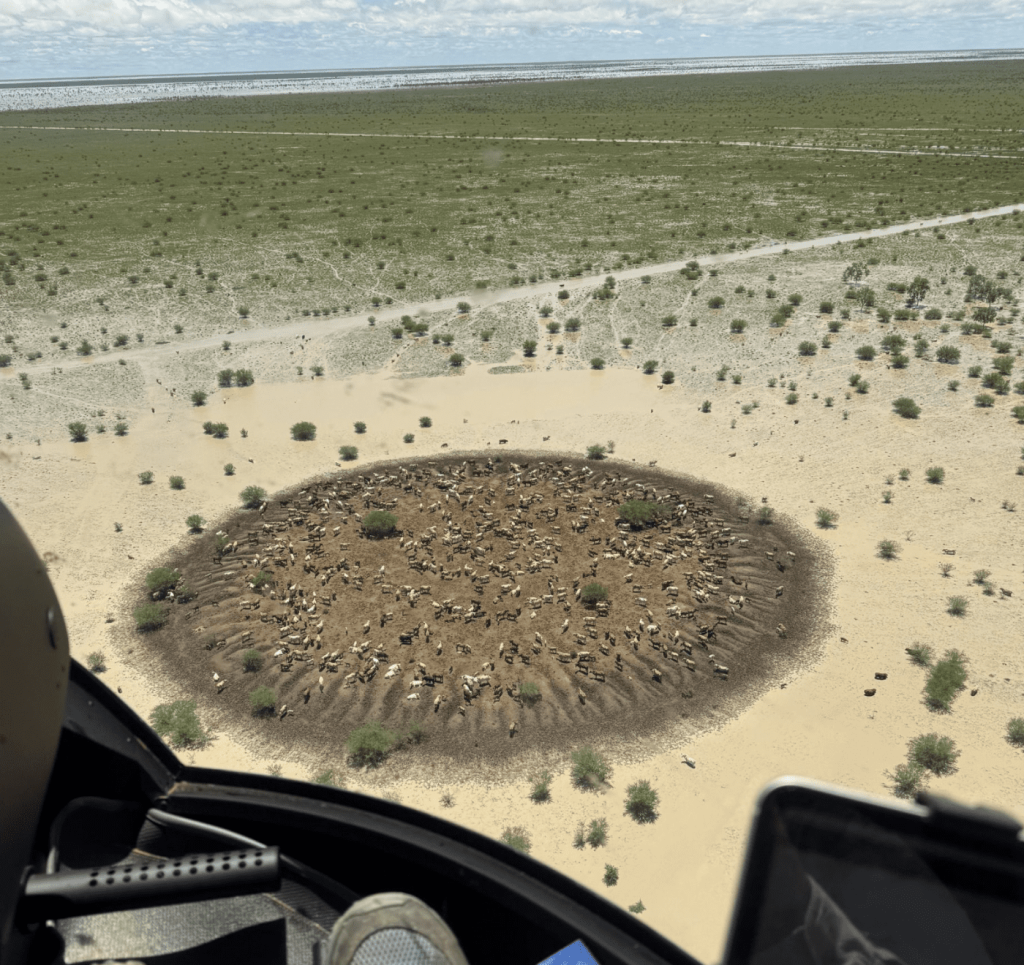
Flood refuge in use during January’s Northwest Queensland floods.
Photo: Scott Elliott from Blue Hills Helicopters in the Carpentaria Shire.
This year’s wet season has put the Flood Refuge Mounds (FRMs) to the test, structures initially developed following the catastrophic floods in North-West Queensland in 2019. Estimates indicate that livestock losses from this year’s floods are nearing 100,000, a stark contrast to the more than 500,000 head lost during the 2019 disaster.
The absence of high ground for livestock to escape floodwaters significantly contributed to the devastating numbers in 2019. In response, Bob Shepherd, Principal Extension Officer with the Department of Agriculture and Fisheries, developed a guide outlining the design, construction, and management of FRMs in 2023. These mounds are intended to offer refuge to livestock during similar flooding events.
According to Mr. Shepherd, approximately 80 to 100 FRMs have been constructed across four corporate pastoral properties on the Lower Flinders River floodplain.
“From the photos I have seen and reports I have been hearing, the FRMs are functioning as designed,” said Mr. Shepherd.
One of Scott Elliott’s photos shows around 750 head of cattle on a mound, a promising sight. However, it’s still early to assess the overall effectiveness of these mounds across the lower Gulf floodplain. Comprehensive evaluations are expected post first-round mustering.
There is growing interest in FRMs following the recent flood events. Mr. Shepherd noted potential adjustments based on this year’s observations for improved future efficacy.
“I would recommend using more topsoil during construction to promote rapid revegetation, thus enhancing mound stability,” he added. “The circular design appears the most efficient, requiring the least soil displacement per head of cattle carried.”
Additional recommendations include creating a slight crown on the top of mounds to prevent water pooling and providing feed supplements to cattle during dry periods. This practice encourages familiarity and comfort with the mounds before flooding occurs.
Reports suggest that during fodder drops, cattle rush and trample to reach the hay, highlighting the necessity of strategic timing for these interventions.
Flood Refuge Mounds are currently a significant topic at this week’s Northern Beef Research Update Conference in Brisbane, reflecting the ongoing commitment to improving flood resilience in North-West Queensland.
This structured article presents the information clearly, leveraging appropriate HTML tags for readability and organization. It would integrate seamlessly into a WordPress site.

