
Shetland MSP opens Scotland’s biggest salmon farm. Scotland’s biggest salmon farm was officially opened by Shetland MSP Hannah Mary Goodlad, marking a new approach to farming with state-of-the-art technology and scaled up infrastructure.
The Scottish Sea Farms Billy Baa marine site, which is located to the west of South Whiteness and Weisdale Voe, represents an investment of £7.5 million, with much of the spend with Scottish suppliers.
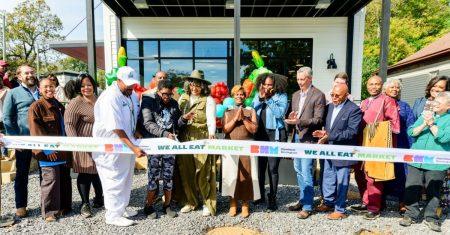
Cutting the ribbon, Goodlad said:
“Shetland’s deeper, cleaner waters and strong currents form an incredible habitat for all our seafood industries, and I am not surprised that Shetland is now to host Scotland’s largest sea farm.
“This project is a great example of Shetland’s unique ability to attract key, high-value investment that builds our economy, grows our workforce and strengthens our supply chain.”
The farm, which was stocked in September and has a biomass consent of 4,091 tonnes, is in keeping with Scottish Sea Farms’ strategy for larger farms in better locations, with deeper waters and faster currents.
Billy Baa has nine 160m pens, the first of this size in Shetland, and one of 120m, provided by Inverness based Gael Force Group. The average water depth is 45m, making this one of the deepest farms within the Shetland estate.
The farm’s £1.8 million workboat was built by Macduff Shipyards and a second smaller personnel vessel was constructed at Arran Workboats.
Farm Manager Peter Muir, who was involved in designing the farm set-up, the new boats and the Scale AQ barge, said the fish will have more room than ever to grow.
‘Even though we have more fish on site, the amount of space they have to swim around in is still extensive. The fish are looking really good; we transferred them from a nursery site at an average weight of 1kg and plan to harvest them next October or November.
‘The size of the farm is not just better for the fish but also for the team here. There is a lot more room on the pens and they are safer because everything is heavier duty, the walkways are much bigger, and the stanchions for the handrails are all chunkier.’
Eight full-time roles have been created at the new farm and staff comfort and safety have been a priority throughout, including on the 16m workboat, Vissa-Dair.
‘The wheelhouse is bigger and we have had security cameras fitted, one on the working deck so whoever is in charge of the boat has perfect vision of who’s doing what, and also in the engine room, in case of fire,’ said Muir.
The 500-tonne capacity steel barge, Scottish Sea Farms’ biggest to date, is fitted with a Fjord Maritime hybrid power system that combines a diesel generator and a bank of batteries to ensure uninterrupted supply 24/7.
Scottish Sea Farms trialled the Fjord Hybrid system at Langa, another Shetland site, and found impressive cost savings as well as improved security, said Shetland Engineering Manager Keith Fraser.
‘With the hybrid system, the batteries can store power from the generator so the bilge pumps are available all day and night in the event of a leak. The internet is also connected 24 hours a day so you can access the cameras remotely, and check the levels of the fuel and water tanks,’ said Fraser.
Another innovation is the installation of a ten-line feeding system so all the pens can be fed at the same time.
‘This makes it easier to manage the site. If bad weather is coming in or if a treatment is planned, you can get the feeding done quickly.’
Also new is a ‘keel cooler’ system for the barge generator which uses the sea to cool the water which cools the engine, rather than air cooler units. The system reduces maintenance, allows more space in the engine room, and because there is no need for large openings for the air ducts, there is less chance of water getting in and the engine room is more secure.
The barge also features what Scottish Sea Farms understands to be the first Fire Eater Inergen fire suppression system installed on a feed barge in the UK, adding another layer of protection for colleagues and infrastructure
The system uses nitrogen, argon and carbon dioxide, gases found naturally in the atmosphere, to reduce oxygen levels and extinguish a fire. It is designed for use in occupied spaces, protecting people as well as equipment.
Boat naming competition
Pupils from nearby Whiteness Primary School attended the opening of Billy Baa, after taking part in a competition to name the farm’s two boats, the Vissa-Dair and Bluey.
‘We were approached by Scottish Sea Farms as our catchment area is in the vicinity of the farm,’ said Head Teacher Rachel Colclough. ‘Our pupils came up with ideas and then Scottish Sea Farms chose the two winning names.’
To celebrate the school’s role in the farm’s launch, Scottish Sea Farms is donating £10,000 towards the purchase of a new reading scheme, plus new novel sets for older children.
‘Our books are very out of date and it would have taken us years to find the money to replace them,’ said Colclough. ‘This gift has made all the difference and we can now buy books that are more relevant to our children.’
Scottish Sea Farms Managing Director Jim Gallagher said engaging the school in the opening of Billy Baa was the highlight of the day.
“The presence of the children reminded us that they are the future and it’s crucial that, as Shetland’s largest private employer, we can offer them a future to look forward to here, with skilled job opportunities to match their talents.
“By growing our business and investing in the Shetland and Scottish economy, as we have done with Billy Baa, we will continue to contribute to the long-term viability of our local communities.”
Billy Baa’s SeaQurePen 500s, supplied by Gael Force Group, are built to withstand the challenging environment in Shetland and will be a much-improved working platform for the farm staff.
A tried and tested double netting system has been installed, with a 75mm mesh outer net and an 18mm mesh inner net, as well as a new ‘glider’ system for the nets to ensure correct tension throughout.
ScaleAQ in Scotland supplied the 500-tonne steel feed barge, which is not just Scottish Sea Farms’ largest barge to date but also equipped with its most advanced hybrid system.
The latest ultra-high-definition feed cameras, supplied by ScaleAQ, have been installed along with a new motorised feed spreader that will reduce power consumption and increase feed spread and availability.
The farm’s £1.8 million 16m workboat Vissa-Dair was built by MacDuff Ship Design and the 9m Bluey was constructed at Arran Workboats.
Scottish Sea Farms spent £27 million last year with Shetland suppliers, supporting 124 local contractors and businesses. Its salary bill in Shetland was more than £15 million. Scotland-wide, the company invested nearly £170 million in the supply chain, supporting 573 Scottish businesses.
Image: Sea Farms Boat Naming Whiteness Primary School – Hannah Mary and Jim Gallagher