
Exploring the Map of Joy: A Journey into the Heart of Local Food Systems
Have you ever encountered a “Map of Joy”? It’s a fascinating concept that encourages us to share and celebrate moments of happiness in our food systems. The Map of Joy in the Food System, developed by the University of Vermont’s (UVM) Institute for Agroecology, serves as a unique tool that fosters collaboration and a collective vision for a thriving local food network.
Insights from the UVM Institute for Agroecology

Shane Rogers, UVM, IFA
Earlier this year, the Organic Farming Research Foundation (OFRF) staff met with Shane Rogers, the Outreach and Narrative Lead at UVM’s Institute for Agroecology. This meeting was particularly significant as Food Solutions New England (FSNE) transitioned much of its programming to form an exciting new partnership with IFA in mid-2025. During this transition, IFA is actively continuing FSNE’s narrative strategy work alongside regional policy initiatives like the New England Integrated Policy Program.
Understanding Narrative Strategy
Shane defines narrative as a “shared interpretation of how the world works.” It embodies the guiding ideas that underpin the communications and initiatives undertaken within communities. Creating a shared narrative necessitates time, trust, and relationship-building, but many professionals in movement-building contexts already possess an inherent narrative, even if it remains unarticulated. Identifying the key messages that resonate within a community is crucial; this could be framed around the environmental benefits of organic farming or the security that comes from providing organic nourishment to one’s family.
Once the core narrative is pinpointed, strategically applying it allows movements to shape public perceptions. Effectively communicating these stories builds culture and shares collective values. The process begins by establishing the narrative’s foundation before framing it for various audiences.
Shared Vision, Distinct Voices
A shared narrative does not imply uniformity in language. Shane explains that while a cohesive narrative might emerge in a lofty, jargon-filled manner, each organization involved can adapt this vision into terminology that resonates with their specific communities. Moreover, narrative transcends mere words; it includes the atmosphere of meetings, programming choices, engagement methods, and the way participants present themselves. All these factors contribute to shaping culture and redefining notions of acceptance within communities.
It’s vital to recognize that narratives are not solely carried by individuals or organizations. Shane encourages seeking out complementary voices and narratives within communities to amplify shared stories. To ensure inclusive representation, inviting reviewers from underrepresented groups can enhance narrative construction while allowing those who are hesitant to participate actively to have a voice in the process without the burden of extensive involvement.
Mapping Joy in the Food System
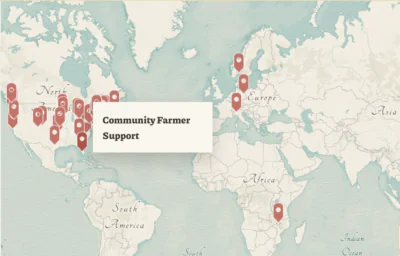
Map of Joy, from IFA
Shane recounted a poignant experience of collaborating with a community of practice to identify a shared narrative. They discovered that joy was a consistent yet overlooked aspect in their food system endeavors. Eager to integrate joy into their work, they launched the Mapping Joy in the Food System project. Utilizing the free ArcGIS mapping tool, this initiative collects individuals’ input through a Google Form, allowing them to narrate their personal experiences of joy in the food system. Contributions vary from stories of farms uplifting those down on their luck, to enjoying the deliciousness of fresh berries and connecting with nature.
The project has garnered entries from around the globe, highlighting the universality of joy in food experiences. IFA maintains momentum by publishing a monthly ‘Moment of Joy’ to propagate these shared experiences and further cultivate a culture of joy.
“Because in trying to articulate what, perhaps, joy is, it has occurred to me that among other things—the trees and the mushrooms have shown me this—joy is the mostly invisible, the underground union between us, you and me, which is, among other things, the great fact of our life and the lives of everyone and thing we love going away. If we sink a spoon into that fact, into the duff between us, we will find it teeming. It will look like all the books ever written. It will look like all the nerves in a body. We might call it sorrow, but we might call it a union, one that, once we notice it, once we bring it into the light, might become flower and food. Might be joy.” – Ross Gay, The Book of Delights
To delve deeper into the ideals and initiatives of the Institute for Agroecology, visit their website. Joining IFA’s Food System Communicators Community of Practice is highly encouraged, along with exploring Shane’s guide on collective narrative development: Strategic Collective Communications: A Workbook for Building Solidarity and Reshaping Communications.

