

The Women’s Day Off in Iceland: A Journey Through History
Fish Focus invites you to explore the inspiring events surrounding the Women’s Day Off in Iceland, a pivotal moment for gender equality. Our latest feature covers our trip to the enchanting Vestmannaeyjar archipelago, where we’ll shine a light on the Icelandic seafood industry, innovative aquaculture, rich heritage, and the warm hospitality of the Icelandic people. Catch our daily articles detailing this amazing adventure and learn more about Iceland’s culture and contributions.
Stay tuned for our full publications available here.
A Flight into History
On our journey to Iceland, we watched an impactful documentary titled The Day Iceland Stood Still. This award-winning film chronicles the extraordinary events leading up to the Women’s Day Off (known as kvennafrí), a day when brave Icelandic women stepped away from both their paid jobs and household duties. Their united actions effectively brought the nation to a standstill, illuminating their essential roles within society.
Photo © The Day Iceland Stood Still
Director Pamela Hogan and producer Hrafnhildur Gunnarsdóttir crafted an engaging and thought-provoking piece of historical cinema, celebrating this pivotal event while reminding us of the often unseen labor that sustains our societies.
Understanding Kvennafrí and the Fight for Equality
On October 24, 1975, Iceland embarked on a significant moment in modern history with the Women’s Day Off, or kvennafrí. This event saw an estimated 90% of Icelandic women walking off the job, refusing to engage in both paid work and unpaid household responsibilities. The demonstration significantly reshaped the nation’s political and social dynamics, paving the way for the fight for women’s rights.
By the mid-1970s, women were increasingly present in the workforce. However, they experienced systemic inequalities, earning considerably less than their male counterparts, with domestic responsibilities overwhelmingly falling upon them. Furthermore, political representation for women was alarmingly low, with only a small proportion of parliamentary seats occupied by women.
This landscape coincided with the United Nations declaring 1975 the International Women’s Year, inspiring discussions and actions in numerous countries. Icelandic women’s organizations saw this as an opportunity to voice their concerns for gender equality.
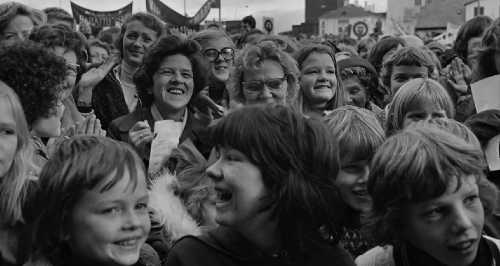
Photo © Kristin Bergthóra Pálsdóttir
The Day of Protest
Rather than labeling the event a “strike,” organizers reframed it as a “day off” (kvennafrídagur) to encourage broader participation and inclusivity. The underlying message was clear: if women ceased their work, both professionally and personally, society would experience significant disruption.
On that historic day, around 25,000 women—almost one-fifth of Iceland’s population—convened in Reykjavík’s city center, with countless others participating across the nation. This inclusive protest showcased the strength and significance of women’s contributions, coming from all walks of life—from teachers and nurses to factory workers and homemakers.
The impact was immediate and profound. Schools and nurseries closed down, compelling fathers to step up as caregivers, while businesses struggled to operate, highlighting the vital role women play in daily life. The Women’s Day Off was a transformative moment for Iceland; it catalyzed change and laid the groundwork for future advancements in women’s rights.
Just five years later, in 1980, Iceland made history by electing Vigdís Finnbogadóttir as the world’s first democratically elected female president—an accomplishment many attribute to the momentum generated by the 1975 demonstration.
A Legacy Beyond Iceland
Since that pivotal day, kvennafrí has been observed on various occasions (e.g., in 1985, 2005, 2010, 2016, 2023, and upcoming in 2025) to address ongoing gender pay gaps and advocate for broader equality. Each iteration calls back to the spirit of 1975, reminding Icelandic society of the continuous journey toward gender equality.
The Women’s Day Off stands as a powerful symbol of collective action across the globe. It demonstrated that when women withdraw their labor, both visible and invisible, it forces societies to confront their dependence on gendered work structures. The 1975 protest continues to inspire feminist movements around the world as a prominent example of how peaceful mass mobilization can lead to real political change.
Fifty years later, the Women’s Day Off remains a beacon of solidarity in the fight for equality. It not only transformed Icelandic politics but also influenced movements worldwide. Kvennafrí serves as a living tradition, reminding us that true progress is achieved when women demand to be seen, heard, and valued.
Main image: Photo © Reykjavik Museum of Photography
This HTML structure is ready for seamless integration into WordPress and is formatted for enhanced readability.

