

Recent Shifts in Australian Lean Manufacturing Beef Prices
After a year marked by consistent increases, the prices for Australian 90CL grinding meat in the U.S. market have recently experienced a significant downturn over the past three to four weeks. Expressed in Australian dollar terms, lean trimmings have dropped approximately A$1/kg since the third week of November.
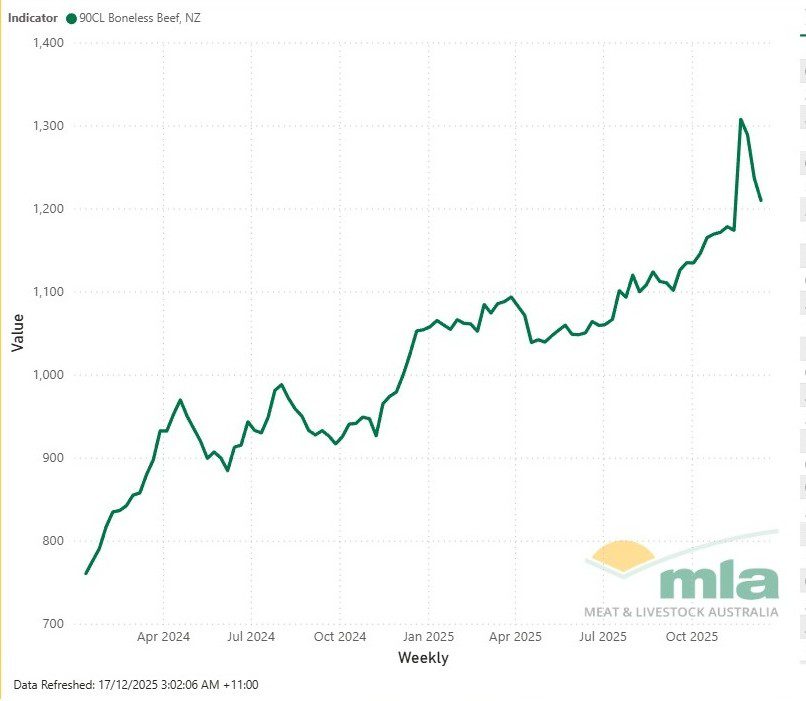
Click on graph for a larger view
As reported by MLA, the market recently peaked at an all-time high of A$13.07c/kg (CIF) during the week of November 21, only to decrease to A$12.09 last week. Some participants in the spot market have quoted prices as low as A$11.20 this week.
Historically, the 90CL prices had never exceeded A$10/kg until the notable surge that began last December. A graph tracking the prices for 90CL imported beef into the U.S. from early 2024 illustrates a steady rise from approximately A$7.60 in January 2024 to the recent peak of just over A$13/kg—an increase of nearly A$5.50/kg or 72% within two years.
Factors Contributing to Price Adjustment
Experts cite three primary factors that have led to this recent price drop:
1. Currency Fluctuations
The first factor is the currency effect. The Australian dollar has appreciated by about US2c since late November, now sitting at mid US66s this week.
2. Large Volumes in Cold Storage
Secondly, there is a substantial volume of imported beef in U.S. bonded cold storage, awaiting the tariff reset on January 1.
3. Increased Competition from Brazil
The third and most significant factor is succinctly captured in one word: Brazil. Recent changes under U.S. President Trump’s administration have eliminated the 50% additional tariff on Brazilian meat entering the U.S., enhancing its competitiveness against Australian imports. Previously, Brazilian beef faced a steep 76.4% total tariff earlier this year.
Beginning January 1, Brazilian beef will be on equal footing with Australian imports, attracting no tariffs initially. However, due to the limited nature of Brazil’s ‘Other Country’ quota for U.S. market access, it is likely that Brazilian meat will fill this quota quickly, subsequently incurring a 26.4% tariff for the remainder of the year.
This year, Brazil completely filled its entire annual quota by January 17, and it is anticipated that this could occur even earlier next year. Estimates indicate that it could be filled 15 days into the new year, primarily with Brazilian products already in cold storage.
Impact on U.S. Buyer Sentiment
As a result of these changes, U.S. buyers are exhibiting a cautious approach, opting to delay purchasing decisions while awaiting the evolving tariff landscape. Unusually high weekly U.S. beef kills recently (600,000 head last week) and fluctuating domestic cattle prices are contributing to a sense of uncertainty among importers. Nonetheless, U.S. domestic beef production is expected to struggle through 2026 due to a beef herd at its lowest levels in 70 years.
According to one trader, “Skittish is an apt description for U.S. imported beef buyer sentiment as we head into 2026.” The Australian export packers’ positions typically span four to six weeks, combined with the closure of larger Queensland plants for the Christmas break, implies current trades may extend into March deliveries.
This sharp decline in imported trimmings prices may reflect a strengthened negotiation position for U.S. importers, aware of the influx of Brazilian meat. While traders note that this is a contributing factor, the sheer volume of Brazilian imports poised to enter the U.S. will undoubtedly alter the supply-demand dynamics.
Future Prospects for Market Dynamics
While the Australian beef sector continues to thrive at the higher quality end of the market, especially in grain-fed production, concerns remain about the potential effects of Brazil’s growth in U.S. market share.
Despite this, many large U.S. end users (like McDonald’s, Costco, and Burger King) continue to favor Australian products due to perceived qualities related to shelf-life and environmental factors. However, the evolving quality and competitive nature of Brazilian beef may pose challenges in the future.
Even as some traders note minimal immediate impact on Australian sales into Japan and Korea—an area anticipated to open to Brazilian beef in the future—it’s clear that these dynamics will shape the landscape of global beef trade in the years to come.
This rewritten article is structured for clarity and readability, formatted in HTML for seamless integration into WordPress, and ensures all content is original and engaging.

