

Assessing Volatility in Australian Cattle Prices: Insights from Rabobank
Are we experiencing greater volatility in Australian cattle prices than ever before? Is this trend limited to cattle, or are other commodities experiencing similar fluctuations? What strategies can producers employ to mitigate these impacts? These pertinent questions are currently being investigated by Angus Gidley-Baird, senior proteins analyst at Rabobank, who is analyzing cattle prices over the last 25 years.
“When grouping years into five-year periods since 2000, we have observed an increasing level of volatility in the Australian cattle market,” Mr. Gidley-Baird explained. “For example, during the period from 2000 to 2005, the price movement for a replacement heifer was around $1/kg. In contrast, between 2020 and 2025, the price fluctuation has escalated to approximately $5/kg.”
As part of his research, Mr. Gidley-Baird is also examining cattle prices from other countries, particularly the US market. “Are US cattle markets experiencing similar fluctuations? They employ financial tools such as futures pricing to hedge risks—are they seeing comparable volatility?” he queried during a recent presentation at the Brisbane Ekka.
Early findings indicate that price volatility is increasing across various commodities and markets globally. “Some theories suggest that the expansion of the market and access to information has contributed to this volatility. Whereas previously, one might only hear about local saleyard events, we now have updates on international news that could influence local decisions,” he remarked.
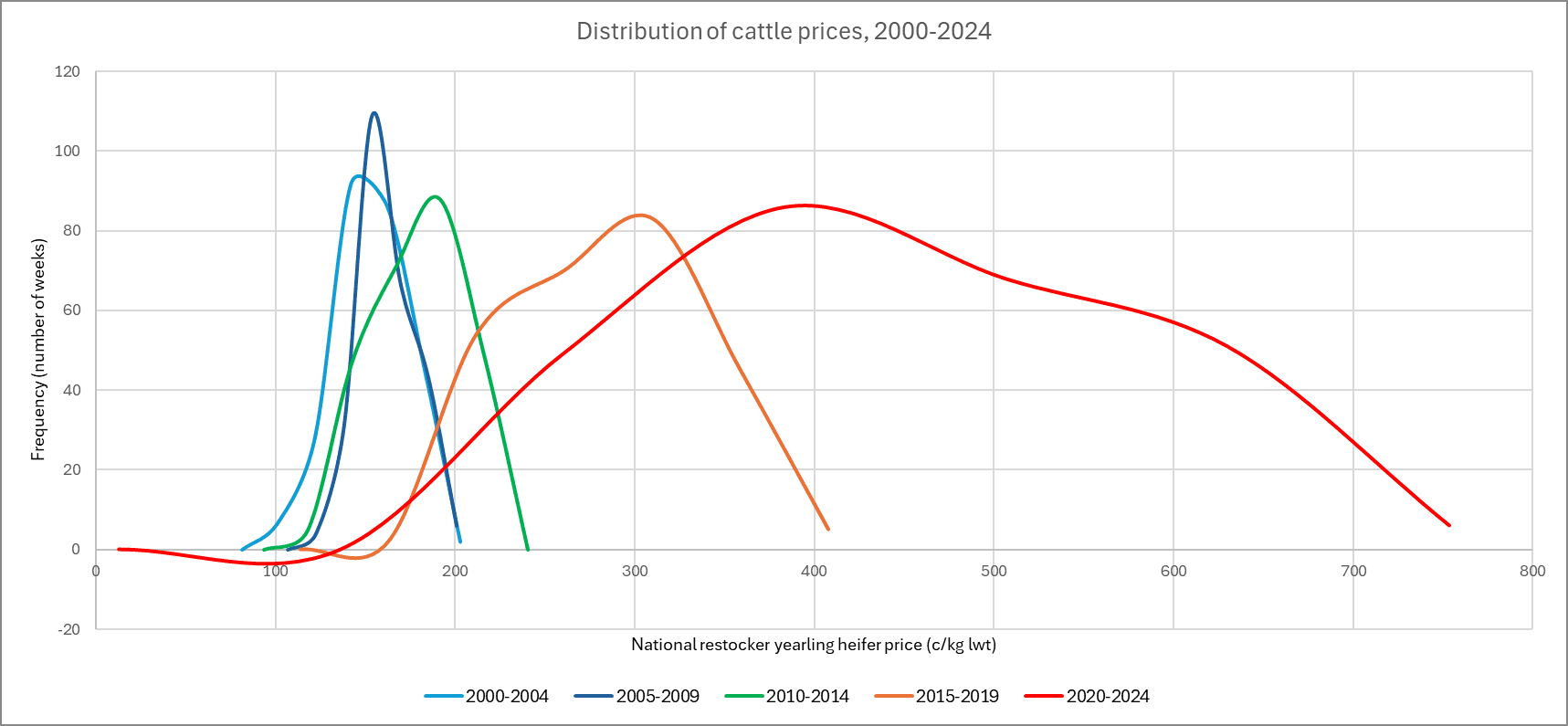
Replacement heifer price distribution from 2000 to 2024. (Source: Rabobank)
Mr. Gidley-Baird noted that while volatility has always been a characteristic of the market, it doesn’t necessarily have to be detrimental. “Many people will recall the significant fluctuations of the 1970s. However, as we entered the 80s and 90s, these peaks and troughs became more consistent. Since the 2000s, though, we have seen a resurgence in volatility,” he stated. “Ultimately, volatility is a part of the landscape, and some individuals can leverage it for profit.”
Forecasting Future Trends
Looking ahead, Mr. Gidley-Baird predicts that the next significant shift in cattle prices could coincide with dry conditions across Australia, compelling producers to sell off their herds. “Given the current pricing of feeder steers is around 400c/kg, will we revert to previous lows, or could prices decline even further if we face substantial cattle sales?” he pondered.
This ongoing research could provide valuable insights for producers navigating the complexities of the changing cattle market, equipping them with the knowledge to make informed decisions amidst increased price volatility.

