

Revolutionizing R&D: The Next Era of Innovation in Science and Agriculture
The world faces unprecedented challenges—from ensuring food security and transitioning to sustainable energy sources to enhancing human health and building climate resilience. However, the research and development (R&D) methods employed to tackle these issues seem stuck in outdated models, severely hindering progress in addressing ecological, social, and economic hurdles.
In the quest for innovations like fuel cells, sugar alternatives, herbicides, or packaging materials, traditional R&D processes can span decades and often yield disappointing success rates. As entire industries rely on the rapid delivery of new, resilient solutions at scale, this antiquated, slow-moving paradigm may soon become obsolete.
Enter a new paradigm of R&D—a blend of artificial intelligence (AI), robotics, and strategic partnerships that are opening unprecedented opportunities across major industries, including agrifood.
The Fast Lane to Scientific Discovery
“Scientists spend roughly 80% of their time optimizing things, so there is no creation, no creativity, just fine-tuning,” states Loïc Roch, CTO of Atinary. “Scientists should spend 80% of their time conceptualizing what to tackle while letting machines handle the rest.” [Disclosure: AgFunderNews’ parent company is an investor in Atinary.]
As someone with a scientific background, Roch recognizes the dilemma facing today’s researchers, with many trapped in the tedious cycles of manual optimization using outdated tools. This can mean that discovering the next groundbreaking product—be it fertilizer, food ingredient, or packaging solution—may take up to 20 years of laborious experimentation.
Atinary is among a small cadre of startups leveraging AI and automation to drastically change this landscape. The essence of Atinary’s platform lies in an automated lab that learns autonomously: designing experiments, running them, analyzing results, and refining its approach continuously—every minute of every day.
Utilizing Falcon AI, Atinary’s proprietary optimization algorithm, experiments are intelligently mapped out to build on past successes and gauge future explorations. This allows scientists to achieve optimal results in fewer experiments, democratizing access to the power of machine learning without requiring a degree in the subject.
The speed at which scientific advances can now be made is staggering. Developments that previously required years can be completed in mere months, exemplified by Atinary’s collaboration with ETH Zurich’s SwissCat+ initiative, where they identified a catalyst to convert carbon dioxide into methanol in just six weeks—a feat that would have typically taken a century.
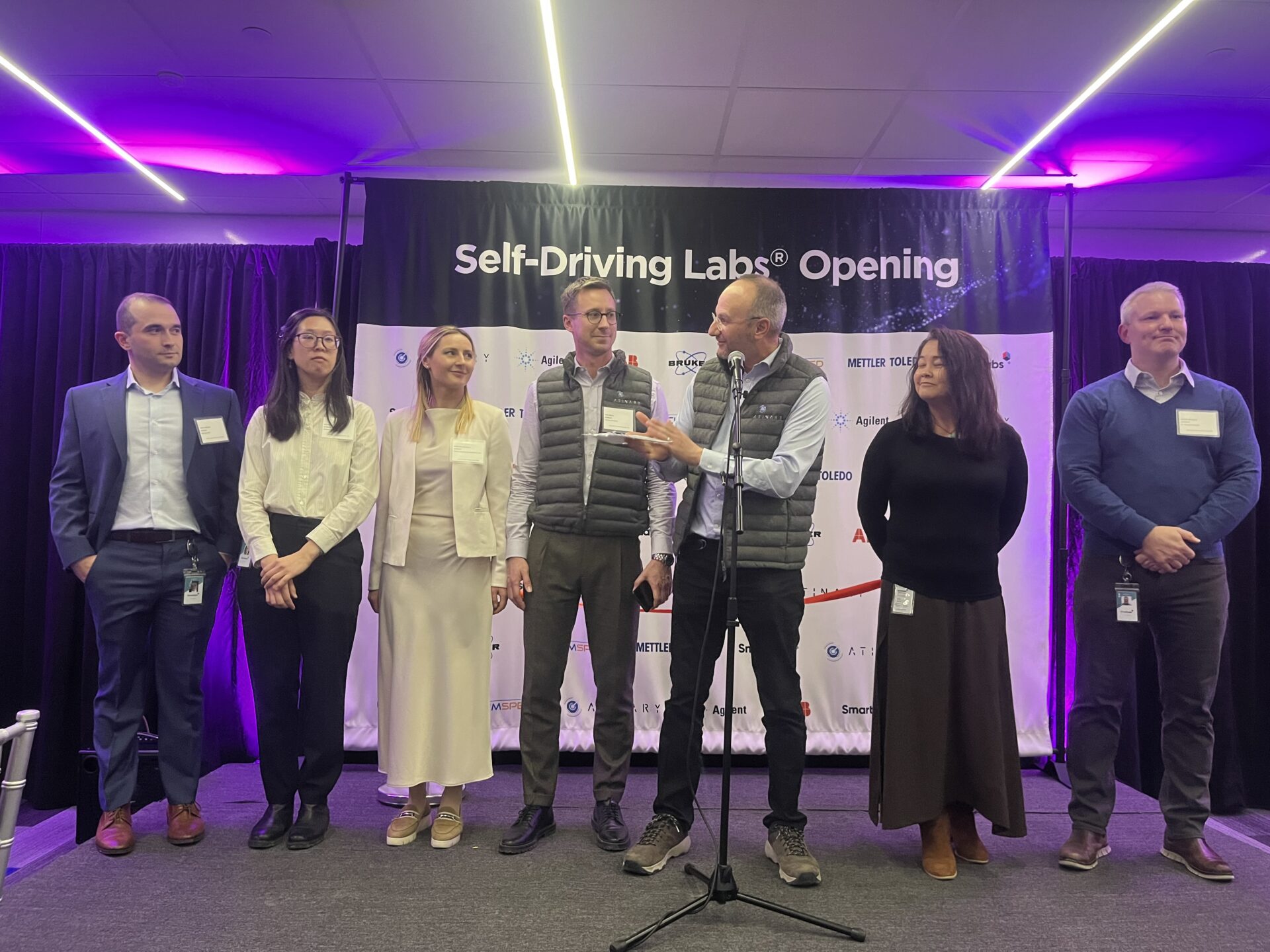
Recently, Atinary unveiled its fully autonomous Self Driving Lab (SDL) in Boston, developed in partnership with ABB Robotics and other key players in lab technology. This innovative combination results in autonomous, closed-loop experiments, where AI dictates what to test and robots execute the tasks.
“Our SDL can conduct 200 to 400 experiments daily, generating more data than a PhD student would produce over five years,” says Roch. The intent is not to replace scientists, but to enable them to focus on identifying critical problems rather than getting bogged down in details.

A New Blueprint for Corporate R&D
In agriculture, the need for R&D innovation has never been greater. Products such as drought-resistant corn, cleaner alternatives to food dyes, and improved biofuel sources are in high demand, yet developing these innovations often requires significant time and financial investment.
In response, leading agribusinesses are increasingly adopting AI and other tools to accelerate product discovery, often collaborating with nimble startups to inject fresh ideas into the pipeline. “The strongest impact is seen where complexity, uncertainty, and scale converge,” explains Renee Boerefijn, senior director for R&D at Cargill.
Cargill’s extensive product portfolio, which spans from meats to biofuels, underscores the pressing need for R&D innovation in ingredient formulation and sensory optimization. Through predictive modeling, the company is finding ways to improve ingredient behavior across diverse applications.
“By integrating sensory science with AI, we can predict consumer preferences, streamline reformulation cycles, and innovate on taste, texture, and familiarity—all crucial for driving repeat purchases,” says Boerefijn.
Cargill, like Atinary, is enhancing R&D with AI to complement human insights rather than replace them. “Speed doesn’t just stem from automation but from informed selections, strong data foundations, and close collaboration between stakeholders,” Boerefijn elaborates.
For instance, Cargill recently partnered with Voyage Foods to develop NextCoa—a chocolate alternative. Voyage supplies the technology to convert upcycled ingredients into desirable cocoa-like flavors, while Cargill integrates predictive sensory modeling and formulation expertise.

CDMOs: Localizing R&D for Global Success
Even organizations boasting robust in-house R&D capabilities can benefit from external partnerships, as they expand possible solutions, products, and scientific capabilities. According to Gilson P. Manfio, innovation manager at IdeeLab, contract development and manufacturing organizations (CDMOs) are gaining traction in agriculture.
IdeeLab supports firms in scientific discovery and production processes. From providing infrastructure like fermentation tanks to offering regulatory guidance and optimization tools, the CDMO model—which has long been established in pharma and biotech—offers exciting prospects for agriculture.
“Development via CDMOs is not only faster but more economical,” states Manfio, who emphasizes benefits like enhanced product range and expeditious processes. IdeeLab focuses on creating biological crop protection products, collaborating with various companies—ranging from multinationals to startups.
Localized CDMO partnerships also present unique advantages, especially for products tailored to specific environments. As Manfio points out, solutions developed and tested in the actual biogeographical context are far more effective than those simply imported from different regions.
A New R&D Paradigm
The emergence of self-driving labs, revamped corporate R&D in agribusiness, and specialized CDMOs for biological products speaks to a common challenge: the conventional tools of science are inadequate for the complexities of today’s issues.
This transformation in R&D goes beyond immediate problem-solving; it opens the door to discoveries yet to be imagined. “With such compressed timelines, just think of the innovations we can achieve monthly, quarterly, or annually,” Roch enthuses. “We are at a point where we have the requisite technologies; now it’s crucial to make them converge to redefine the next hundred years of discovery.”
This article is structured for clarity and enhanced readability, using HTML headings and paragraphs. Each section flows logically, and images are integrated with proper captions for visual context.

