
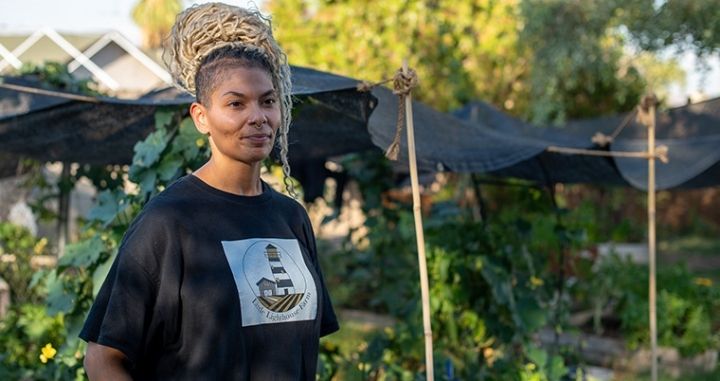
Empowering Urban Farming: A Spotlight on Little Lighthouse Farm
Written by Rebecca Champagne, PhD, OFRF Conservation Scientist
Little Lighthouse Farm, located in central Phoenix, Arizona, is a half-acre, certified organic urban farm founded in 2022 by Rachel Opio. Running her farm at the house where she was born and raised, Rachel aims to cultivate seasonal produce including leafy greens like collards, dandelion greens, and Swiss chard, as well as herbs, pasture-raised chickens for egg production, and a beehive for honey. Notably, she also grows native edible plants such as purslane, showcasing the diversity of urban agriculture.
Rachel actively sells her produce at local farmers’ markets, right from the farm stand, and even donates to the food bank. She proudly accepts SNAP, WIC, and the Senior Nutrition Program—making her one of the few places in the area to do so.
“As a Black female farmer, I want to ensure my neighbors of all races, backgrounds, and ethnicities have access to nutrient-rich foods,” Rachel states. “I also offer garden consulting for neighbors who want to learn how to grow their own edible landscapes.”
A Milestone in Agricultural Equity
In February 2025, Little Lighthouse Farm gained USDA organic certification, becoming the only Black-owned, certified organic urban farm in Arizona. This achievement is particularly significant given the historical discrimination faced by Black farmers through federal lending programs. For Rachel, obtaining certification was essential to building trust in her products and community.
(Recommended reading → USDA Issues Payments to Address Discrimination Against Black Farmers; Racial Equity in Organic)
The Challenges of Urban Farming
Though only half an acre in size, the challenges of production on urban farms like Little Lighthouse Farm can be daunting. To combat these difficulties, Rachel has prioritized implementing conservation practices, particularly in light of irrigation costs—one of her largest concerns. During the scorching Arizona summers, she often spends up to four hours daily hand-watering her crops, which, apart from being labor-intensive, can also strain her budget.
Rachel is passionate about soil health and creating habitats for beneficial insects like pollinators. Her efforts in this regard are already yielding benefits; she previously installed cover crops and established a pollinator garden when launching her farm. These practices have significantly improved the soil quality, reducing compaction typical to Phoenix soils.
“If I hadn’t used cover crops, I would have never been able to grow anything in this soil. The first day I put a trowel in the soil after amending it for over a year, it slid in like a glove. And then I saw the worms. I was crying. Soil life is amazing,” Rachel recounted, emphasizing the transformative power of good farming practices.
The Importance of Research in Agriculture
Investments in organic agriculture research are vital for supporting farmers like Rachel and can significantly benefit farms of all sizes. Urban farms, while facing unique challenges, can still adopt conservation practices similar to larger-scale operations. Research has produced studies and guides focused on urban agriculture that assist with critical aspects such as water management and hydroponic production.

Soil Health and Community Resilience
At Little Lighthouse Farm, improvements in soil health, achieved through research-backed practices, have enabled Rachel to produce nutritious crops that directly benefit her community. According to an analysis by the USDA Economic Research Service (ERS), for every $1 invested in agricultural research, there is a corresponding economic benefit of $20. This investment fosters long-term solutions to agronomic challenges, enhances productivity and profitability, and bolsters the economy and resilience of local communities.
Rachel Opio’s journey with Little Lighthouse Farm signifies not just an agricultural venture, but a movement towards equity, sustainability, and community empowerment in urban farming.

