write a new articles with
Microgreen Mediums: Testing Jute Verses Soil
Written by Mary Hathaway, OFRF’s Research & Education Program Manager, and Tiffany Sanders, FLT Program participant
This on-farm trial at Sanders Funny farm will compare the effectiveness of jute fiber mats verses soil as the growing medium for a variety of microgreens. Results from this study will help organic farmers produce healthier microgreens and reduce crop losses.
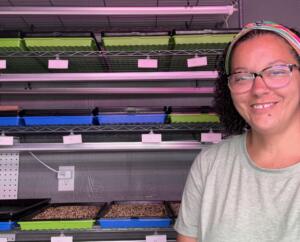
Farmer Tiffany Sanders in her microgreen production greenhouse.
Mike and Tiffany Sanders, co-founders of Sanders Funny Farm in Indianapolis, Indiana, didn’t come to farming through a traditional path. With 11 kids, 2 grandkids, and “a revolving door of critters,” the name Funny Farm practically chose itself. At the heart of their operation is a thriving greenhouse microgreens enterprise, where Tiffany grows a diverse lineup of nutrient-dense crops–broccoli, radish, chia, arugula, wheatgrass, and more–sold through their online farm market and delivered directly to customers across Indiana.
Tiffany is committed to growing her operation to make local food easy, consistent, and affordable. Recently her farm and greenhouse became certified through California Certified Organic Farmers (CCOF). Looking ahead, Tiffany envisions expanding her microgreens line to include more specialty and difficult-to-grow varieties, making her farm a more resilient and diverse supplier. To do that, she knows she needs reliable, data-backed answers about which growing systems actually work, and which ones work best.
Growing Better Microgreens
Since launching her microgreens operation, Tiffany has relied primarily on jute fiber mats, a hydroponic-style growing medium standard in the industry, to grow her crops. Jute mats are convenient, clean, and widely-used, performing well for many varieties. But as Tiffany expanded her lineup and worked to grow more challenging crops, cracks began to show. Varieties like arugula and cilantro struggled with mold and moisture issues on jute. Each failed tray represented not just lost revenue, but a missed opportunity to serve her customers.
At the same time, Tiffany began wondering whether soil-grown microgreens might offer advantages she hadn’t fully explored, like better germination consistency, sturdier stems, more vibrant color, and improved shelf life. These qualities matter enormously in a market where perishability directly affects whether a product can be sold. A tray of microgreens that wilts quickly or arrives limp at market is as good as no tray at all.
The challenge was that Tiffany didn’t have rigorous, side-by-side data to compare the two mediums. Her observations were real, but anecdotal. She needed a structured trial that could tell her, with confidence, whether soil was worth integrating into her production system and, if so, determine which varieties and under what conditions. That question became the foundation of her application to OFRF’s Farmer-Led Trials program.
into a unique and well structured article. Ensure the new content is plagiarism-free, well-organized, and formatted for seamless integration into WordPress. Use appropriate HTML tags (e.g.,
,
,
) and enhance readability with proper formatting